Why the Second Side Always Feels Different in Yin
Quick Answer: Four things stack up. Your body is genuinely asymmetric - hip sockets, leg lengths and habitual patterns all differ side to side. The first side warms the whole system, so the second side starts from a different physiological baseline. You already know what is coming, so your attention and your expectation change. And the first side has just released tension that partly crosses the midline. This is normal and does not need fixing, though a persistent large difference is worth noticing.
Same pose. Same five minutes. Same props.
And the right side is a quiet unfolding while the left is a negotiation from the first thirty seconds.

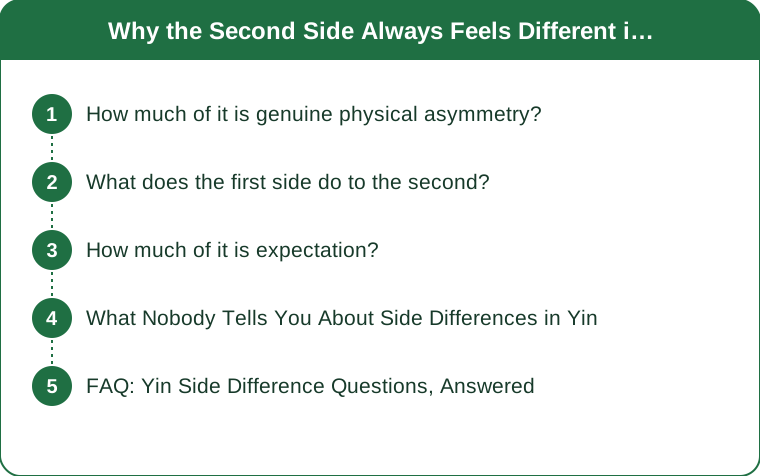
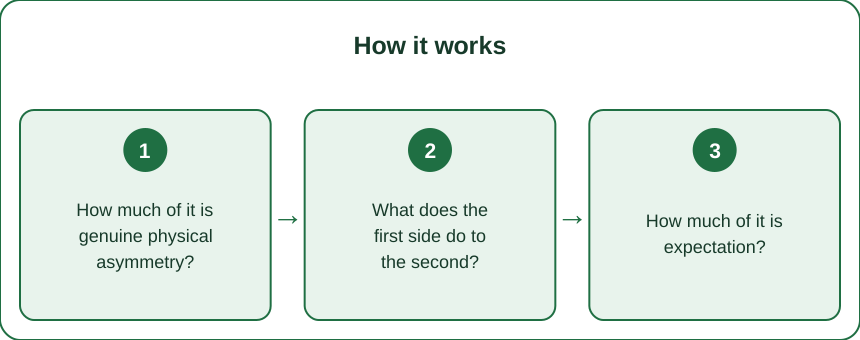
How much of it is genuine physical asymmetry?
A good deal. Hip socket depth and orientation differ between sides in most people, and that is bone, not tissue - it sets a hard limit that stretching does not move.
Leg length differences of up to a centimetre are common and change the angle at which a pose loads the hip.
Habitual patterns are deeply asymmetric. Which side you carry a bag on, which leg you cross, which hip you stand on - all of it accumulates over decades.
Old injuries leave asymmetry long after they stop hurting, because the movement pattern adopted to protect them tends to outlive the injury.
Sports and work are usually one-sided, and anyone who has played a racquet sport or worked at a fixed desk position carries the signature of it.
Which means expecting the two sides to feel identical is expecting something anatomy does not offer.
What does the first side do to the second?
Core temperature rises during the first hold, so the tissue on the second side starts warmer and more compliant.
The nervous system settles. Yin depends heavily on down-regulation, and by the second side the parasympathetic shift is already underway.
Fascia has some cross-body continuity, so releasing tension on one side changes the tension picture on the other in ways that are not purely local.
Breathing has usually deepened by then, which changes rib and diaphragm mechanics and therefore what the spine and hips can do.
You have already found the prop height and the exact angle, so the second side skips most of the fidgeting the first side needed.
And attention has narrowed. The first side is partly setup and partly settling; the second is the one you actually spend inside.

How much of it is expectation?
Knowing the duration changes the experience substantially. The first side is open-ended in feeling even if you set a timer; the second has a known shape and a known end.
You anticipate the sensation, which reliably alters how intense it registers - sometimes lower, sometimes higher if the first side was difficult.
A hard first side primes you to brace, and bracing is precisely what makes a yin hold harder.
A comfortable first side can make you overreach on the second, going deeper than the tissue wants because the expectation is easy.
Attention drifts differently by then. The second side often has more mind-wandering, which changes how long it feels and how much of the sensation you actually register.
And once you have noticed the difference between sides, you look for it, which is its own reliable amplifier.
What Nobody Tells You About Side Differences in Yin
Practising the tighter side first is worth trying, and most people never do. The convention of leading with the right is arbitrary. If one side is consistently harder, starting there gives it the full attention of a fresh mind and the whole session ahead of it, rather than the warmed-but-distracted second slot. Some teachers then return to it briefly at the end, which is a different and often more useful arrangement than simply holding it longer.
Holding the tight side longer is a less good idea than it sounds. The intuition is to even things up with time, but in yin the tissue response is not linear with duration, and a longer hold on an already-irritated side often produces more guarding rather than more release. Equal duration with better prop support usually beats unequal duration.
Props are where the actual asymmetry work happens. Using a higher block on one side is not cheating and it is not an admission of failure - it is acknowledging that the two hips are shaped differently. Two identical setups on two different hips produce two different poses, which is the opposite of what you wanted.
The difference varies enormously day to day. People conclude they have a permanent imbalance based on one session. Sleep position, which side you drove on, how long you sat, and where you are in a cycle all shift it. The pattern that matters is the one you see across a month, not the one you feel on Tuesday.
Big side differences in the spine deserve more attention than big side differences in the hips. Hip asymmetry is extremely common and usually unremarkable. A consistent, marked difference in a spinal twist or side bend - particularly one that comes with pain rather than just restriction - is the version worth mentioning to a physiotherapist rather than practising through.
And the second side is where most of the actual yin happens. The first side is the price of admission: settling, prop-finding, letting the nervous system arrive. Experienced practitioners often report that the second side is where the practice becomes what it is meant to be, which reframes the whole comparison. The two sides were never doing the same job.
FAQ: Yin Side Difference Questions, Answered
Should I always start on the tighter side?
It is worth experimenting with. A fresh mind and a full session ahead can suit the harder side better than the warmed-but-tired second slot.
How much difference is too much?
Restriction differences are normal. Marked differences that come with pain, that appear suddenly, or that keep growing over months are worth having assessed.
Will the tight side ever catch up?
Partly. Tissue restriction responds to consistent practice; bone shape does not. Expect improvement rather than symmetry.
Should I use different props on each side?
Yes. Different hips need different support, and matching prop heights on unmatched hips gives you two different poses.
Why does the difference change day to day?
Sleep position, activity, sitting time, hydration and the menstrual cycle all shift it. Judge by the monthly pattern rather than by one session.
Does the same apply to twists and side bends?
Yes, but spinal asymmetry is worth watching more carefully than hip asymmetry, particularly if pain rather than restriction is the limiting sensation.
TL;DR:
- Real anatomical asymmetry - socket shape, leg length, decades of habit - sets a floor that stretching does not remove.
- The first side warms the system and settles the nervous system, so the second starts from a different baseline.
- Expectation changes the experience in both directions: a hard first side primes bracing, an easy one invites overreaching.
- Different props on each side is the correct response, not a compromise.
- Judge asymmetry by the monthly pattern; pain rather than restriction is the signal that needs a professional.
The two sides were never doing the same job, so identical is the wrong target.
Keep Reading
This article is for general informational purposes only and is not medical advice. Always consult a qualified health professional for guidance specific to you.