Why Yin Yoga Brings Up Emotion and What Is Actually Happening
Quick Answer: Emotion surfaces in yin because of what the practice removes rather than what it does. Long stillness, no counting, no external focus and a shift toward parasympathetic dominance strip away the distraction that normally keeps low-grade emotional material below the surface. Add sustained mild discomfort and slow breathing, and you have close to ideal conditions for something to come up. It is common, it is not a sign of damage, and it does not need to be interpreted.
Nothing is being released from your hips. Something is finally being noticed.
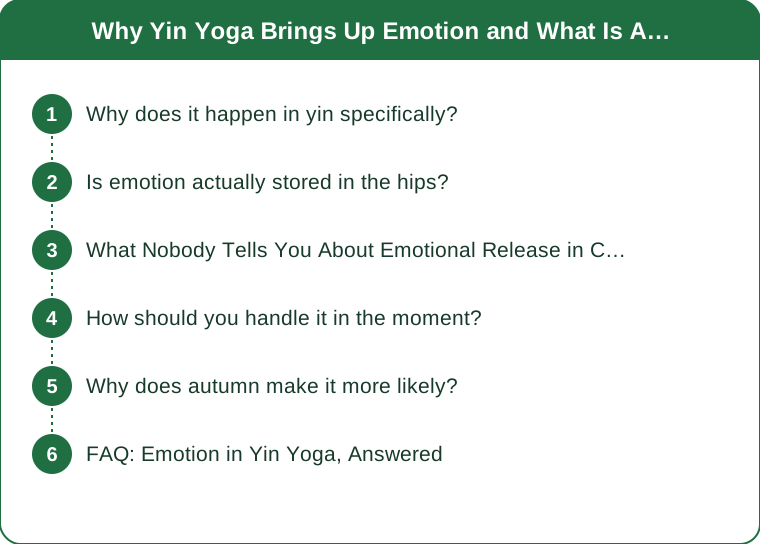
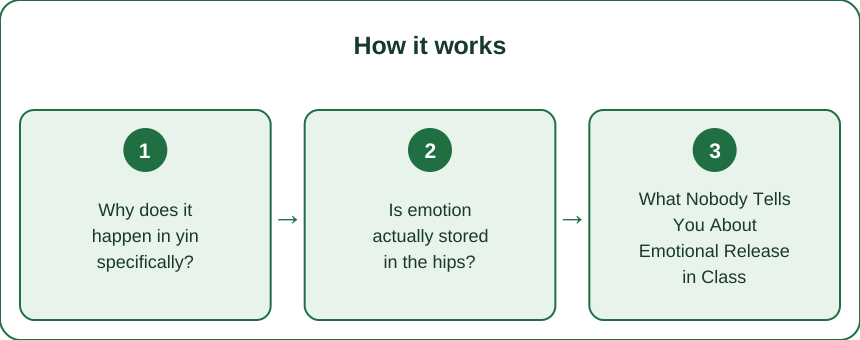
Why does it happen in yin specifically?
Yin removes every available distraction at once, which no other common practice does to the same degree.
There is no sequence to follow, no count, no music cue and no next pose to anticipate for three to five minutes at a stretch.
Vigorous practice keeps attention externally occupied with balance, breath timing and transitions; yin does not, so attention turns inward by default.
Slow diaphragmatic breathing in a supported position shifts autonomic balance toward the parasympathetic branch, and that shift reliably lowers the threshold at which emotion registers.
Sustained mild discomfort adds a second ingredient. Staying with an uncomfortable sensation without escaping it is unusual, and it borrows the same tolerance that difficult feelings require.
So the conditions are: no distraction, downshifted nervous system, and practised tolerance of discomfort - which is a fairly precise description of the setting in which people cry.
Is emotion actually stored in the hips?
The hips-as-emotional-storage idea is a metaphor that has been repeated until it sounds like anatomy, and it is worth separating the useful part from the literal claim.
Connective tissue does not store memories or feelings. There is no mechanism by which fascia encodes emotional content.
What is true is that stress changes muscle tone, including in the hip flexors and adductors, and chronic stress produces measurable resting tension.
It is also true that hip openers are frequently where emotion appears in yin classes, which is what generated the metaphor in the first place.
The more likely explanation is duration and intensity. Hip poses are typically the longest and most uncomfortable holds in a yin sequence, so they supply the strongest dose of exactly the conditions described above.
A five-minute uncomfortable shoulder hold produces the same effect in plenty of people, which is what you would expect if position matters less than duration.
What Nobody Tells You About Emotional Release in Class
Nobody tells you how ordinary it is. Teachers see it constantly and mention it rarely, which leaves students assuming it happened only to them.
Nobody tells you it usually needs no interpretation. The strong urge to work out what the feeling is about often makes it worse, and letting it pass unexamined works better for most people.
Nobody tells you it is more likely in the evening, at the end of a demanding week, and in the first cold months of the year - all of which are load factors rather than anything about you.
Nobody tells you that coming out of the pose is allowed. Yin is not an endurance test, and there is no benefit in staying in a hold that has become genuinely distressing.
Nobody tells you the third thing, which surprises people most: crying in a yin class rarely feels bad. It is usually closer to relief than to sadness, and people frequently cannot say what it was about.
And nobody tells you what to do afterwards, which is mostly nothing - drink water, stay warm, do not drive straight into a demanding evening if you can avoid it.
How should you handle it in the moment?
Stay if it feels tolerable, and come out if it does not. Both are correct responses and neither is a failure.
Lengthen the exhale. Breathing out for roughly twice as long as you breathe in reliably steadies the nervous system within a few breaths.
Let the feeling be unlabelled. You do not need to know what it is about, and the search for a cause often intensifies it.
Reduce the intensity of the pose rather than leaving it entirely if you want to stay with it - add a bolster, a block, or less depth.
Open your eyes if you feel unmoored. Visual input is the fastest available way to reorient, and there is no rule that yin requires closed eyes.
And give yourself a slow exit. Coming out of a long hold quickly and standing straight up is unpleasant physically as well as emotionally - roll to one side and rest for a few breaths.
Why does autumn make it more likely?
Cooler rooms make yin holds noticeably harder, and the added discomfort increases the intensity of the whole practice.
Less daylight through autumn affects mood for a substantial share of people, which raises the baseline that a practice can bring to the surface.
Early autumn is also a genuinely high-load period - schedules restart, the year’s pace picks up, and accumulated summer slack disappears within a fortnight.
Practise warmer than you think you need to. Socks, a long-sleeved layer and a blanket over you in the final holds change the experience substantially.
Move your practice earlier in the evening as it gets dark sooner, since a late cold practice compounds every factor at once.
And expect more of it in October and November than in July. That is the season, not a change in you.
FAQ: Emotion in Yin Yoga, Answered
Why do I cry in yin yoga?
Long stillness removes distraction, slow breathing shifts your nervous system toward rest, and sustained mild discomfort lowers the threshold at which emotion registers. It is common and it is not a sign that anything is wrong.
Is emotion stored in the hips?
Not literally. Fascia does not encode feelings. Hip poses are typically the longest and most uncomfortable holds, which supplies the strongest dose of the conditions that bring emotion up.
Should I stay in the pose?
Stay if it feels tolerable, come out if it does not. Yin is not an endurance test and there is nothing to be gained from staying in a distressing hold.
Do I need to figure out what it was about?
Usually not. The search for a cause frequently intensifies the feeling, and most people find it passes better unexamined.
What should I do afterwards?
Exit slowly, drink water, stay warm, and avoid going straight into a demanding evening if you can.
Why is it worse in autumn?
Colder rooms make holds harder, shorter days affect mood for many people, and early autumn is a high-load period. This is general information, not medical advice - if strong distress persists after practice, speak to a professional.
TL;DR:
- Emotion surfaces in yin because the practice removes distraction, downshifts the nervous system and asks you to tolerate discomfort - not because tissue stores feelings.
- Hips are where it usually shows up because those holds are the longest and most uncomfortable, not because of anything anatomical.
- Staying and coming out are both correct; lengthen the exhale, reduce depth, or open your eyes.
- It rarely needs interpretation, and searching for a cause often makes it worse.
- Autumn raises the odds: colder rooms, less daylight, and a high-load season all stack.
Exit slowly, stay warm, and give yourself an unhurried hour afterwards if you can. This is general information, not medical advice.
Keep Reading
This article is for general informational purposes only and is not medical advice. Always consult a qualified health professional for guidance specific to you.