Why Yin Poses Feel Harder in the Morning Than in the Evening
Quick Answer: Overnight your spinal discs rehydrate and become stiffer, your body temperature is at its lowest, and your tissues have been immobile for hours. All three reduce available range. Morning yin is genuinely harder and needs more props, shorter holds and a warmer room — it is not a sign that you have lost anything.
Last night you folded forward and rested your forehead on your shins.
This morning you are somewhere around your knees.
Nothing regressed. You just slept.

What actually changes overnight?
Three things, and the first one surprises most people.
Your spinal discs rehydrate while you lie down. Through the day, compressive load squeezes fluid out of the intervertebral discs — which is why most people are measurably shorter in the evening than the morning, often by a centimetre or two. Overnight the discs reabsorb fluid and swell, which increases spinal stiffness and reduces flexion range first thing.
This is why forward folds are so much harder at 7am. It is also why loaded spinal flexion in the first hour after waking is generally advised against — the discs are at their most hydrated and least tolerant.
Your core temperature is at its lowest in the early morning. Body temperature follows a circadian rhythm, bottoming out a couple of hours before you wake. Cold tissue is stiffer tissue, and connective tissue in particular is temperature-sensitive.
And you have been immobile for seven or eight hours. Synovial fluid distribution and tissue viscosity both change with movement, so any joint feels less free when you have not moved it since midnight.
Add an autumn bedroom at 16 degrees and the morning version of a pose can be dramatically different from the evening one — which is a seasonal effect, not a personal one.
Does that mean evening is the better time to practise?
For range, yes. For everything else, not necessarily.
Evening practice gives you more available range. Warmer tissue, decompressed discs, and a day of movement behind you all mean you get deeper into shapes with less resistance.
But depth is not the point of yin. The practice targets connective tissue with long, low-intensity holds, and the sensation you are looking for is a moderate, tolerable stretch — not maximum range. You can find that sensation just as effectively at a shallower depth in the morning.
Morning practice has advantages evening practice does not. It is less likely to be displaced by the rest of the day, and gentle movement first thing helps with the general stiffness people notice as autumn arrives.
Evening yin genuinely helps with sleep for many people, largely through the downregulating effect of long holds and slow breathing. That is a real and useful benefit.
And a practical point: the risk profile differs. In the evening, the temptation is to go too deep because it is available. In the morning, the risk is forcing into a range your tissue is not ready for — which is where people get into trouble. Different times, different cautions.
What Nobody Tells You About Morning Yin
The adjustments that make it work are mostly environmental, not postural.
Room temperature matters more than anything else you can control. A 16 degree room in October changes the practice completely. Heating the room, or practising in warm layers you shed as you go, is worth more than any prop.
Give yourself a short movement preparation, even though yin is traditionally cold. Two or three minutes of gentle cat-cow, hip circles and shoulder rolls is not a warmup in the conventional sense and it addresses the immobility of the night. Many teachers include this specifically for morning classes.
Use more props in the morning, without negotiation. A bolster under the hips in a forward fold, blocks under the knees in a butterfly, a blanket under the seat. Props let you find the correct sensation at a shallower depth, which is exactly what morning requires.
Shorten the holds slightly. If your evening practice uses four to five minute holds, two to three is more appropriate first thing, particularly in the first few weeks.
And avoid deep spinal flexion in the first 30 to 60 minutes after waking. Given the disc hydration picture, sequencing hips, shoulders and side body first, and saving forward folds for later in the practice, is a sensible ordering that costs nothing.
How should you structure a morning practice?
A specific sequence that respects what the body is actually like at 7am.
Start with two to three minutes of gentle movement. Cat-cow, seated side bends, ankle and wrist circles. Nothing held.
Then open with a supported side body or shoulder shape rather than a forward fold. A supported reclining twist or a threaded needle works well and does not ask anything of the spine in flexion.
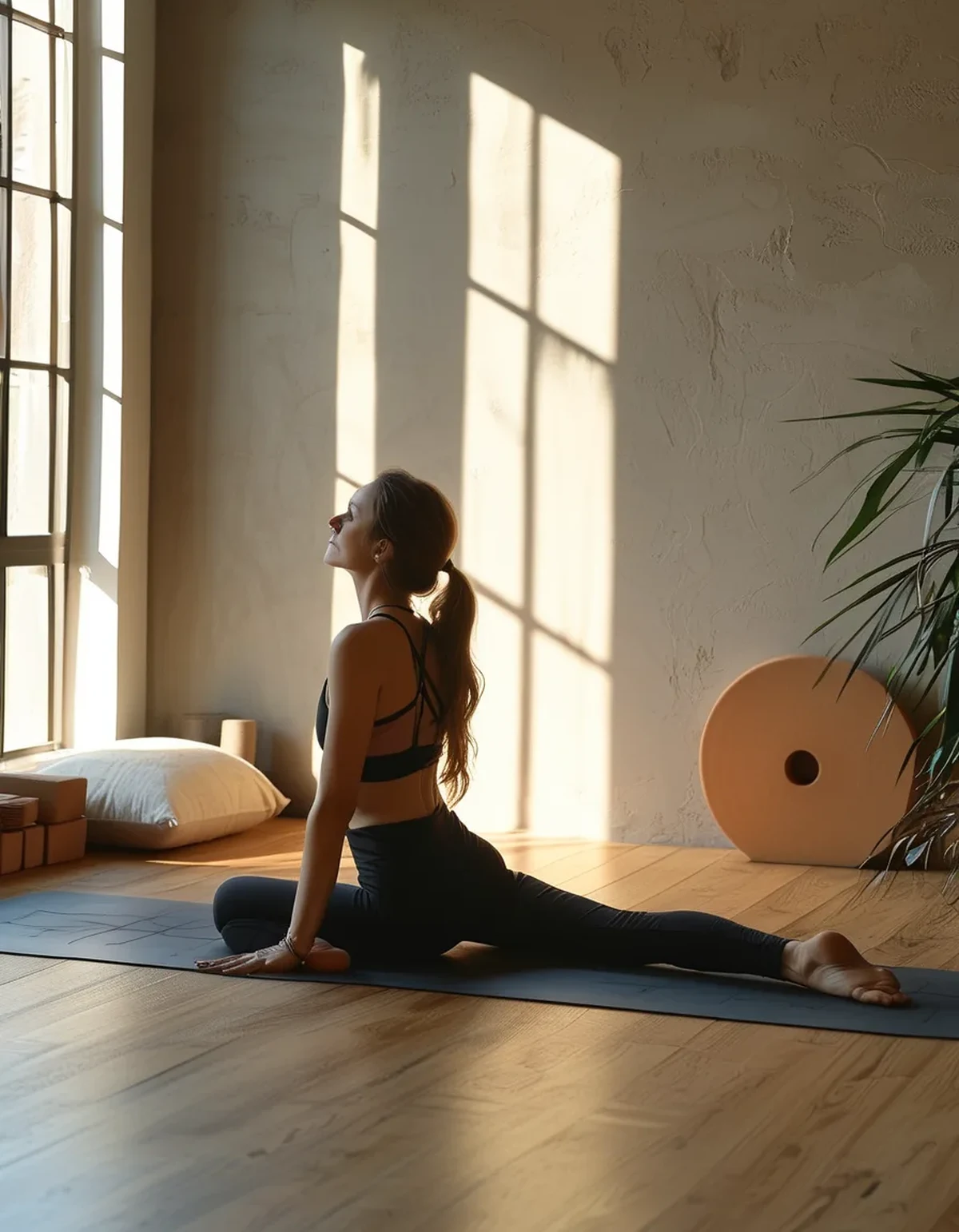
Move to hips next. Butterfly with a bolster, or a supported half-pigeon. These respond well to warmth and props and are less affected by the disc situation.
Save forward folds for the last third. By then you have been moving for twenty minutes and your tissue temperature has risen.
Finish with something restorative for three to five minutes. Legs up the wall or a supported reclining shape.
Keep holds to two or three minutes and use the breath as your gauge. If your breath is short or held, the shape is too intense — back off with a prop rather than pushing through.
And expect the practice to change through the autumn. As mornings get colder, you will need more warmth and more support for the same practice. That is the season, not a regression.
If you have a history of disc problems or persistent morning back pain, talk to a professional about morning sequencing specifically — this is general information, not medical advice.
FAQ: Yin Timing Questions, Answered
Should I practise yin before or after strength training?
After, or on a separate day. Long passive holds immediately before loaded training can transiently reduce force output and joint stiffness, both of which you want available when lifting. Yin sits well in the evening of a training day, or on a rest day.
Is it bad that I can go deeper in the evening?
No, it is expected, and chasing your evening depth in the morning is the actual risk. Judge each practice on the sensation you find, not on how far you got yesterday.
How long before I see permanent change in range?
Meaningful, lasting changes in tissue length take months of consistent practice rather than weeks, and they show up as your worst days improving rather than your best days getting better. Track how your morning practice feels over a season, not over a fortnight.
TL;DR:
- Spinal discs rehydrate overnight, making the spine stiffer and forward folds much harder at 7am.
- Body temperature is at its lowest in the early morning and cold tissue is stiffer.
- Morning yin needs more props, shorter holds, a warmer room and a different sequence.
- Save deep spinal flexion for the last third of a morning practice.
- Evening gives more range but depth was never the point of the practice.
If your morning practice has quietly got harder over the last few weeks, check the thermostat before you check yourself. Autumn does most of this.
Keep Reading
This article is for general informational purposes only and is not medical advice. Always consult a qualified health professional for guidance specific to you.