Why the Order of Yin Poses Changes the Whole Practice
Quick Answer: Sequence order matters in yin because tissue responds to sustained load in a specific progression and because the nervous system needs time to downshift. Open with poses that are easy to settle into, place the deepest work in the middle third, and finish with symmetrical, supported shapes - never with the most intense pose of the practice.
Most home yin practices are a pile of favorite poses in whatever order they occurred to you.
That produces a fine session. It also produces the one where you cannot settle for twenty minutes, or where you leave feeling activated rather than calm and cannot work out why.
Order is doing more than you think - both to the tissue and to the part of the practice that is actually the point.

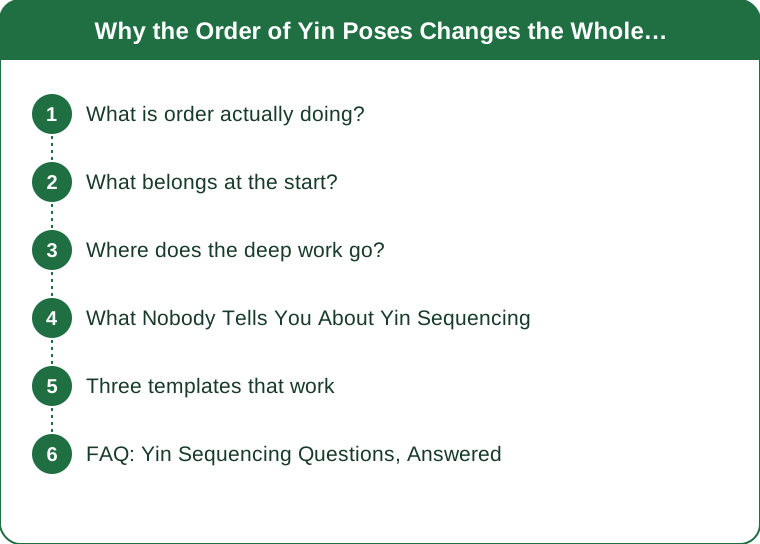
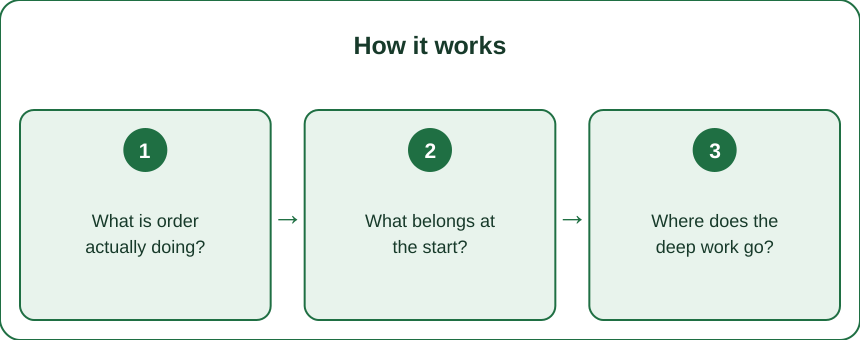
What is order actually doing?
Two things running in parallel.
Tissue. Yin targets connective tissue - fascia, ligaments, joint capsules - through long holds of 3-5 minutes. Connective tissue responds slowly and cumulatively. A hip opener placed after two other hip poses meets tissue that has already been loaded, and it will feel dramatically different than the same pose placed first.
Nervous system. The parasympathetic shift that makes yin restorative is not instant. It builds over the practice, and it is fragile - a pose that produces significant intensity early can keep you in a mildly activated state for the following twenty minutes.
The practical consequence: the first two poses are not warm-up in the yang sense. They are permission. Their job is to let your system decide it is safe to stop bracing, and everything after depends on whether that happened.
What belongs at the start?
Poses you can settle into within about 60 seconds, with props already in place.
Good openers: supported butterfly, reclining twist, child’s pose with a bolster, sphinx. All symmetrical or easily supported, none demanding.
What does not belong at the start: dragon, deep pigeon variations, anything where your first minute is spent negotiating with sensation. Starting with intensity means your nervous system spends the whole first pose on alert, and the practice never fully downshifts.
One specific note: start with something that touches the ground broadly. Poses with a large contact surface - lying down, supported forward folds - signal safety more effectively than poses that balance or hold you up. That is a big part of why the practice traditionally starts on the floor rather than seated upright.
The opener should also be a pose you know well. Novelty requires attention, and attention is the thing you are trying to release.
Where does the deep work go?
In the middle third of the practice.
By then the tissue has had 10-15 minutes of gentle sustained load and the nervous system has downshifted. That combination is when a deep hip or shoulder pose is both most effective and most tolerable.
A useful structure for a 60-minute practice:
- Minutes 0-15: two accessible poses, well supported
- Minutes 15-40: the deep work - two or three poses, including anything intense, done both sides
- Minutes 40-55: integration - gentler poses, twists, gentle counterposes
- Minutes 55-60: savasana, non-negotiable
The most common home-practice error is putting the deep pose at the end because it feels like a climax. That leaves your system activated at the exact moment the practice is supposed to be releasing, and it is the reason some sessions leave you wired rather than calm.
What Nobody Tells You About Yin Sequencing
Counterposes matter more in yin than in yang. After a long backbend, tissue needs a gentle opposing shape - not a deep one. A five-minute sphinx followed by a two-minute child’s pose is complete. A five-minute sphinx followed by a five-minute deep forward fold is two intense poses in a row pretending to be a counterpose.
The second side is always different, and sequencing can exploit that. Practising side A, then a brief neutral shape, then side B produces a more balanced result than going straight across - the neutral shape lets the first side release before you load the second.
Repetition within a practice is legitimate. Returning to a pose you did at minute ten, at minute forty, is one of the most informative things you can do - the same pose in a downshifted system is a completely different experience, and it is a direct measure of whether the practice is working.
Not every practice needs deep work. A full session of accessible, supported poses is a complete yin practice and often the more useful one after a hard training week. The instinct to include at least one intense pose is a yang instinct that snuck in.
And savasana is part of the sequence, not the end of it. Skipping it removes the integration period where the parasympathetic shift consolidates. It is the most commonly cut and least skippable five minutes in the whole practice.
Three templates that work
The Wind-Down (45 min, evening). Supported butterfly 5 - reclining twist 4 each side - caterpillar 5 - supported bridge 5 - legs up the wall 8 - savasana 6. No intensity anywhere, everything supported, structured entirely for the downshift.
The Hip Practice (60 min). Child’s pose 4 - sphinx 4 - dragon 4 each side - swan 5 each side - reclining twist 3 each side - supported butterfly 5 - savasana 6. Deep work sits at minutes 12-35, exactly where it belongs.
The Post-Training Practice (35 min). Supported reclining butterfly 5 - sphinx 3 - half saddle 4 each side - caterpillar 5 - legs up the wall 8 - savasana 3. Shorter, targeting the front line that gets shortened by running and cycling.
Hold times in minutes. Adjust to your own tolerance - the structure survives changes to the timing, but it does not survive rearranging the order.
This is general information, not medical advice. If you have a joint condition, recent injury, or are pregnant, work with a qualified teacher on modifications rather than following a template.
FAQ: Yin Sequencing Questions, Answered
Does the order matter for a short 20-minute practice?
More, not less. With less time the nervous system has less runway, so opening with something accessible matters even more. A 20-minute practice is comfortably two poses plus savasana.
Can I do yin in the morning?
Yes, though the sequence should differ - morning tissue is stiffer, so start gentler and hold slightly shorter. Some people find morning yin better with a brief walk beforehand.
Should I always do both sides?
For structural balance, yes as a default. The exception is a targeted practice for a specific one-sided issue, where an asymmetric practice is deliberate rather than accidental.
TL;DR:
- Order affects both tissue response and the nervous system downshift, and the second one is the point.
- Open with poses you can settle into in a minute, well supported and familiar.
- Put the deep work in the middle third, roughly minutes 15-40 of an hour.
- End with gentler symmetrical shapes and never skip savasana.
- Returning to an early pose later in the practice is the best measure of whether it worked.
A pile of good poses makes a fine practice. A sequence with a shape to it makes the practice do the thing you came for - and it costs nothing but two minutes of planning before you get on the mat.
Keep Reading
This article is for general informational purposes only and is not medical advice. Always consult a qualified health professional for guidance specific to you.