How to Hold a Yin Pose Alone With a Timer Without Bailing Early
Quick Answer: Solo yin fails at the two-to-four minute mark, when the initial sensation has settled and there is nothing external holding you in. Fix it with a timer you cannot see — interval chimes rather than a countdown — a fixed sequence decided before you start, and a specific attention task for the middle of each hold. The problem is structure, not willpower.
In class: five minutes passes.
At home: you check the timer at 1:40, at 2:20, at 2:50, and get out at 3:05 having practised checking a timer.
Here is what actually changes it.
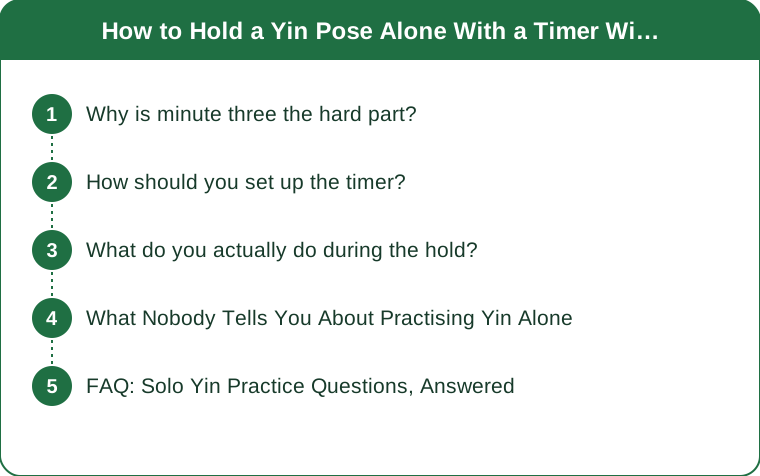
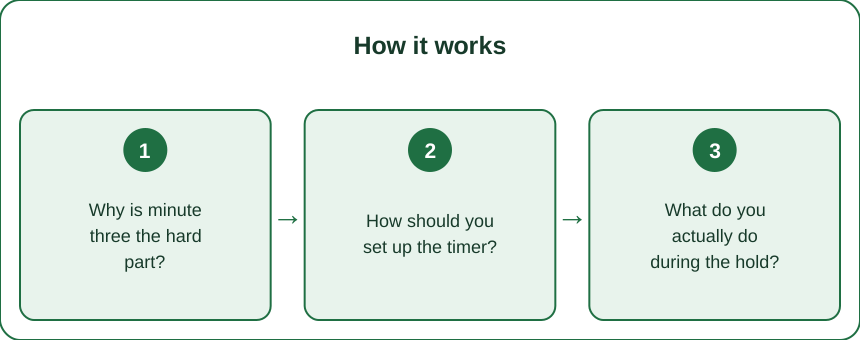
Why is minute three the hard part?
Four things converge at almost exactly that point.
The initial sensation has plateaued. The first ninety seconds of a yin hold has novelty — you are settling, adjusting, feeling the shape arrive. Once that settles, there is no new information, and the mind starts looking for something to do.
Yin is deliberately uncomfortable in a low-grade way. Long passive holds create a dull, spreading sensation that is meant to be tolerable and is genuinely not pleasant. In class, the social contract holds you there. Alone, nothing does.
The countdown itself is the problem. A visible timer converts the practice into waiting. Watching a number descend makes time feel slower and turns attention outward to the clock, which is the opposite of the point.
And the decision to stay is re-made continuously. In class, the decision is made once, by someone else. Alone, you are re-deciding every twenty seconds, and each re-decision is a chance to bail. Removing the decision is the single most effective intervention — which is what a pre-set sequence and an unseen timer actually do.
How should you set up the timer?
Five specifics that make the difference between practising and clock-watching.
Use interval chimes, not a countdown. Set an app to chime every 3, 4 or 5 minutes. You hear when to move, and you never see how long is left. Most meditation apps do this, and a basic interval timer app works fine.
Put the phone face down and out of reach. Face down removes the visual pull; out of reach removes the possibility of a casual check. If you can see the number, you will look at it.
Decide the full sequence before you start. Four poses, five minutes each, written down or memorised. Deciding what comes next during the practice reintroduces the decision point you were trying to remove.
Use a warm-up chime. Some people find a soft chime at the halfway mark reassuring rather than distracting — it converts one long unknown into two known halves. Worth trying both ways.
And put it on aeroplane mode. A notification during minute four of a hold ends the hold. This is not a discipline issue; it is a design issue.
What do you actually do during the hold?
Give attention a job. Five options, and one is usually enough.
Count breaths. The simplest and most effective. Roughly 20-25 slow breaths is a five-minute hold for most people, so counting doubles as a timer and gives the mind a task that keeps it in the body.
Do a slow body scan. Move attention deliberately from feet to head, spending several breaths on each area. This is a structure to follow rather than time to endure.
Track the sensation itself. Where is it now, and where was it thirty seconds ago? Yin sensation genuinely migrates and changes during a hold, and following that change is interesting rather than tedious.
Lengthen the exhale. Breathing in for four and out for six or eight nudges the nervous system toward a calmer state and gives you something to do at the same time.
Or use audio. A yin-specific recording with a teacher’s voice reinstates exactly the external structure that class provides. This is not cheating — it is using the thing that works while you build tolerance for the version without it.
What Nobody Tells You About Practising Yin Alone
Shorter holds done consistently beat long holds abandoned. Three minutes completed is worth more than five minutes bailed at three. Start where you can finish, then extend.
Props change everything and most people at home use too few. In class the props are laid out for you. At home people go without because getting up feels like a hassle. A bolster or two cushions under the hips or knees transforms how sustainable a hold is — and yin is supposed to be supported.
The hardest pose to hold alone is the one you are worst at. Obvious in hindsight, and it means solo practice tends to quietly drop exactly the shapes you most need. Put the hard one second, not last.
Cold makes holds much harder. As the room cools, staying still for five minutes gets genuinely uncomfortable and your body starts asking to move for warmth rather than for escape. Socks, a jumper, and a blanket over you — passive practice in a cool room needs more warmth than you think.
Bailing sometimes is fine. Yin is not an endurance test, and there is a real difference between the dull spreading sensation that belongs in the practice and sharp, pinching or nerve-like pain that does not. Sharp pain, tingling or numbness means come out, adjust, and add support. That is skill, not weakness. This is general information, not medical advice — anyone with joint conditions, recent injury, or who is pregnant should get individual guidance.
FAQ: Solo Yin Practice Questions, Answered
How long should I hold each pose?
Three to five minutes is the common range for yin. Start at three and build — completing is what matters.
Should I use a countdown timer?
No. Interval chimes with the phone face down removes the clock-watching that ruins solo practice.
Why is it so much harder at home?
No external structure holds you there, so the decision to stay gets re-made every twenty seconds. Pre-planning the sequence removes the decision.
What should I think about during a hold?
Give attention a task: count breaths, scan the body, or track how the sensation changes. Unstructured attention drifts to the clock.
How many poses in a home session?
Four to six poses is a solid 20-30 minute practice. More is not better.
Is using a guided recording cheating?
Not at all. It reinstates the external structure that makes class work.
When should I come out of a pose early?
Sharp pain, pinching, tingling or numbness — always. The dull, spreading sensation is the practice; those are not.
TL;DR:
- Solo yin fails at minute two to four, when novelty ends and nothing external holds you in.
- Interval chimes, phone face down and out of reach. A visible countdown turns practice into waiting.
- Decide the whole sequence before you start — removing the decision is the actual fix.
- Give attention a job: count breaths (20-25 is about five minutes), scan, or track the sensation.
- Three minutes completed beats five minutes bailed, and use more props than you think you need.
Try one session with the phone face down and a chime every four minutes. It is a different practice.
Keep Reading
This article is for general informational purposes only and is not medical advice. Always consult a qualified health professional for guidance specific to you.