The Yin Sequence for the Evening After a Long Hike
Quick Answer: A long hike loads the hips eccentrically on descent and repetitively on ascent, leaving the deep hip rotators, hip flexors, and calves in a shortened, guarded state. Yin’s long, passive holds suit this well — but not immediately after, and not aggressively. Wait two to three hours, use props generously, hold 2 to 4 minutes rather than 5 or more, and stop well short of your usual depth.
You did nine miles with a proper descent and now, several hours later, your hips have set like concrete and everything you do involves a small grunt.
This is the ideal evening for yin and the worst evening to go deep. The third section is the sequence; the second explains why depth is the wrong goal tonight.
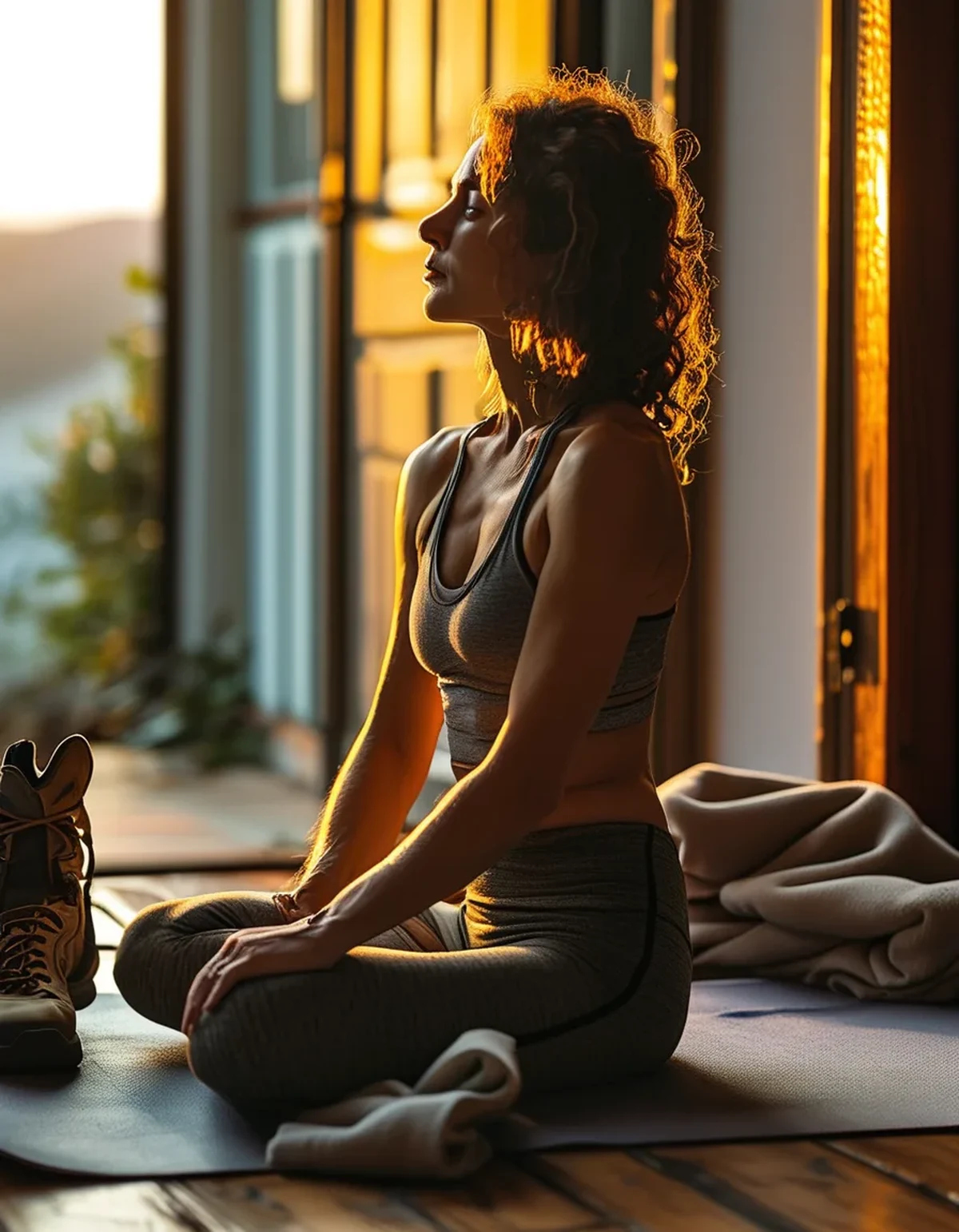
What does a long hike actually do to your hips?
Different things on the way up and the way down, which is why post-hike stiffness feels so comprehensive.
On the ascent: repetitive hip flexion under load, with the glutes and hip extensors working continuously. Your hip flexors are cycling through a shortened range thousands of times, and if you carried a pack, the load on the hip and lower back is sustained.
On the descent: this is where the real damage happens. Downhill walking is heavily eccentric — your quads and hip stabilizers are lengthening under load with every single step to control your descent. Eccentric contractions produce more muscle damage than concentric ones at equivalent effort, which is why the day after a big descent is worse than the day after an equivalent climb.
Throughout: the deep hip rotators work constantly on uneven terrain, stabilizing against every slight change in footing. This is load your body almost never encounters on flat ground or in a gym, and it is why hikers report a specific deep, hard-to-locate hip tightness that ordinary stretching does not touch.
Your calves and ankles too. Uphill loads the calf through a large range; downhill loads the anterior shin and the ankle stabilizers.
Critically: what you are feeling that evening is partly tissue damage and partly protective guarding. The nervous system increases muscle tone around tissue it perceives as vulnerable. That guarded tone is not something to force through — and understanding that is the key to why tonight’s session should be gentle.
Why should you go shallower than usual tonight?
Because the tissue state has changed, and yin’s usual logic assumes tissue that has not been damaged.
Yin works by applying long, low-load stress to connective tissue and by allowing the nervous system to release protective tone. That works beautifully on a normal day. Tonight, two things are different.
Your proprioception is less reliable. Fatigued muscle gives poorer feedback about where you are in a range. You can end up considerably deeper than you would normally choose without noticing, and yin’s long holds mean you are there for minutes.
Damaged tissue under prolonged stretch is more vulnerable. Eccentrically loaded muscle has micro-damage. Adding a five-minute passive stretch at end range to tissue in that state is not additive recovery — it is additional stress.
And guarding exists for a reason. The elevated tone around a fatigued hip is protective. You can override it with a long enough hold, and overriding a protective response on a joint that has just done nine miles of uneven terrain is not a great idea.
So tonight’s adjustments:
Wait two to three hours after finishing. Immediately post-hike, go for gentle movement and food instead.
Hold 2 to 4 minutes rather than 5 or more.
Use more props than usual — bolsters, blocks, folded blankets. The goal is support, not depth.
Target roughly 50 to 60 percent of your normal edge, not 80.
Come out of every pose slowly, and move gently between them. Transitions are where post-hike sessions produce cramps.
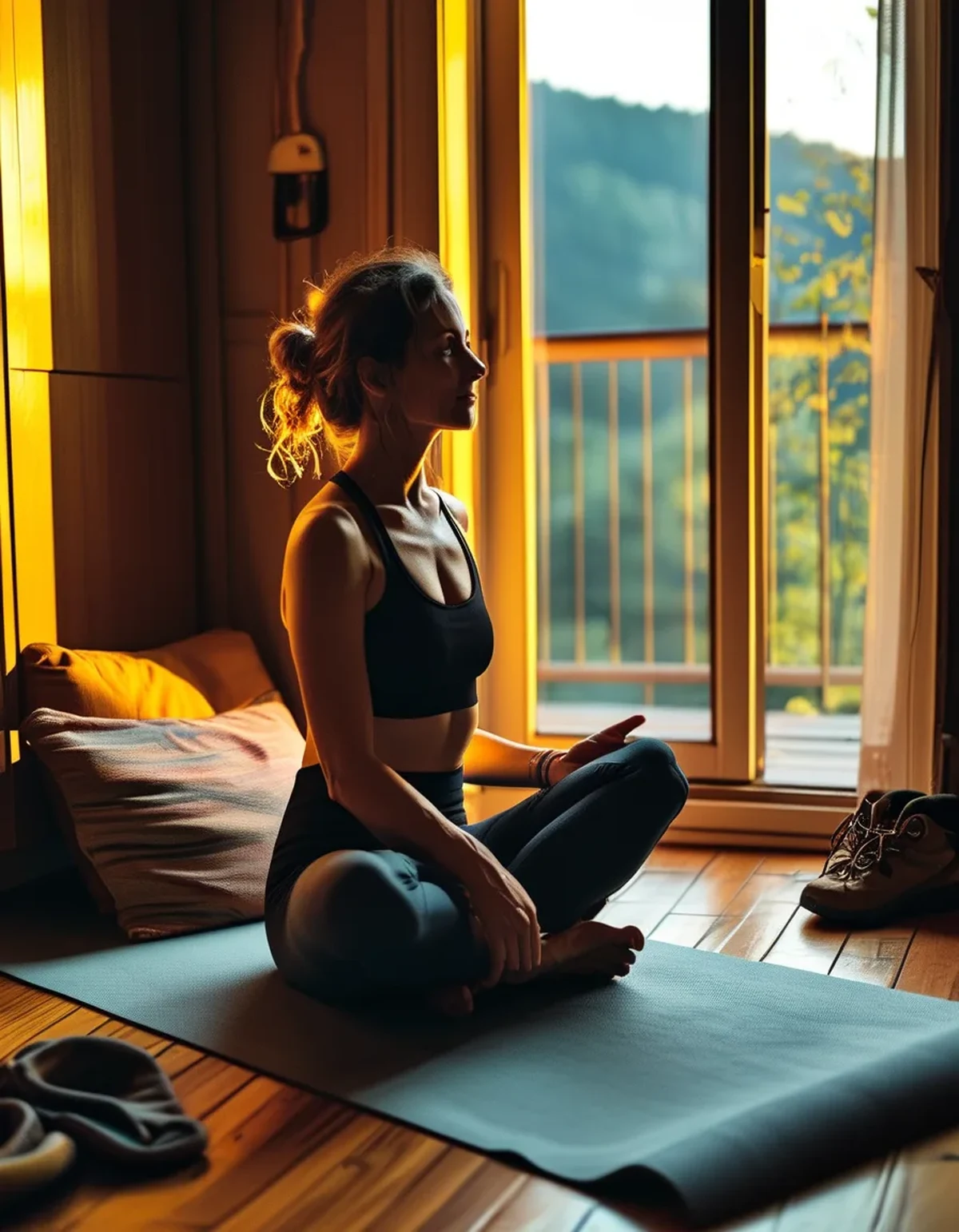
The sequence: seven poses, about 30 minutes
Do them in this order. Every one is proppable, and props are the point tonight.
1. Supported reclined butterfly — 3 minutes. On your back, soles together, knees supported by blocks or cushions so there is no active stretch at all. This is a settling pose. Breathe slowly and let your legs be heavy.
2. Supported bridge — 3 minutes. Block or bolster under your sacrum, legs long or bent. Gentle passive hip flexor opening with zero effort, and it feels wonderful on a tired lower back.
3. Half butterfly, each side — 2 to 3 minutes. One leg extended, one folded in. Fold forward over the extended leg with a bolster under your chest so you are resting, not reaching. Targets hamstrings and the outer hip.
4. Sleeping swan with generous support, each side — 3 minutes. The classic hip opener. Put a folded blanket under the hip of the folded leg — most people need more support here than they think, and post-hike is not the night to test that. If the front knee feels anything sharp, come out immediately and substitute the reclined figure-four instead.
5. Reclined figure-four, each side — 2 minutes. On your back, ankle across the opposite thigh, hands behind the supporting thigh. This is the safer deep-rotator option and it is genuinely as effective for most people.
6. Supported child’s pose or dragonfly — 3 minutes. Bolster under the chest. Wide knees. Lets the inner thigh and lower back release without effort.
7. Legs up the wall — 5 minutes. Finish here. Excellent for tired legs and a genuinely calming end to the day.
Optional add-on: two minutes with your calves over a rolled towel, ankles gently circling. Hiking calves appreciate it.
What Nobody Tells You About Post-Hike Recovery
The stiffness peaks on day two, not day one. Delayed onset muscle soreness after a big descent typically peaks 24 to 48 hours later. The evening session helps tonight and does not prevent Sunday — and expecting it to leads people to go too hard tonight in an attempt to head it off.
Gentle movement on day two does more than stretching does. A short easy walk on the sorest day genuinely helps more than another long stretching session. The instinct to rest completely is usually wrong.
Hydration and food matter more than the yoga. A long hike is a substantial energy expenditure and often a poorly-fueled one. Eat properly that evening — carbohydrate and protein — and drink. Cramping that night is far more likely to be about fluid, sodium, and fatigue than about tightness.
Your hip flexors were probably not the problem. Everybody stretches hip flexors after a hike. The deep rotators and the outer hip usually did more of the unusual work, particularly on uneven terrain, and those respond to the figure-four and swan family rather than to a lunge.
Yin is not the only tool and it is a very good evening one. It combines the physical with a genuine down-regulation of the nervous system at the end of a long day outdoors, which is a large part of why it feels so appropriate.
If something is sharp, one-sided, and specific — particularly at a joint line, in a knee, or in the front of a hip — that is not soreness. Stop, and get it assessed if it persists. This is general information, not medical advice.
FAQ: Post-Hike Yin Questions, Answered
How soon after a hike can I do yin?
Wait two to three hours. Immediately after, your tissue is warm and your proprioception is at its least reliable, which is the combination most likely to produce a stretch that goes too far. In the meantime: walk gently, shower, eat, drink. The evening session is better than the trailhead one.
Should I hold poses longer because I am more tight?
No — shorter tonight, not longer. Perceived tightness after a hike is largely protective tone and tissue damage rather than genuine shortening, and long end-range holds on damaged tissue add stress rather than releasing it. Two to four minutes at moderate depth is the right dose.
Is yin better than a foam roller after hiking?
They do different things and both are reasonable. Foam rolling may reduce perceived soreness in the short term, and yin adds a nervous-system down-regulation that rolling does not. On a post-hike evening, gentle rolling of the calves and quads followed by a supported yin sequence covers both — with the same caution about pressure: gentler than usual on tissue that has just done a long descent.
TL;DR:
- Descent is eccentric and does most of the damage; uneven terrain loads the deep hip rotators in a way gyms never do.
- Post-hike tightness is partly tissue damage and partly protective guarding — do not force through either.
- Wait two to three hours, hold 2 to 4 minutes, prop generously, and work at 50 to 60 percent of your usual depth.
- Reclined figure-four is the safer deep-rotator option; support the hip in sleeping swan more than usual.
- Soreness peaks on day two, and a short easy walk then helps more than another long stretching session.
The evening after a long hike is one of the nicest times to practice yin, as long as you are honest about what it is for. Tonight it is a way of coming down from a day outdoors and giving tired hips somewhere soft to land — not a chance to finally get into that pose you have been working on.
Keep Reading
This article is for general informational purposes only and is not medical advice. Always consult a qualified health professional for guidance specific to you.