Knee Pinching in Butterfly or Dragon? Fix the Setup, Not the Pose
Quick Answer: Knee discomfort in yin poses almost always means the hip is not moving and the knee is absorbing the difference. In butterfly, move your feet further from your body and support both outer thighs with blocks or rolled blankets so the legs are held rather than hanging. In dragon, place a bolster under the front hip and keep the front shin more vertical. And distinguish the sensations: a broad stretch is fine, but pinching, sharpness, or anything at the inner or outer joint line is a stop signal.
Yin is supposed to be about long, quiet holds. If your knee is talking to you at minute two, the pose is not going to improve by minute five.
Why do knees complain in hip-opening poses?
Because a knee is a hinge and a hip is a ball and socket, and the body will find rotation wherever it is available.
In butterfly, the intent is external rotation at the hip. If your hips do not have that range available today — and range varies a lot day to day — the rotation has to come from somewhere. The knee joint offers a small amount of rotational give, and that is what you feel.
The geometry matters more than flexibility. The closer your heels are to your body, the more external rotation the pose demands. People pull their feet in because it looks like the pose in the picture, and that specific choice is the most common cause of butterfly knee pain.
Gravity is the second factor. In an unsupported butterfly your legs hang, so their entire weight pulls on the knee joint continuously for five minutes. That is a long time for a passive joint to be loaded at an angle it did not choose.
Yin holds are long enough that small misalignments accumulate. A position that feels neutral at 30 seconds can feel wrong at three minutes, which is why the setup deserves more attention here than in a flowing practice.
How do you set up butterfly so the knees stay quiet?
Three adjustments, in order of importance.
1. Move your feet away from your body. Start with your heels a full 12 to 18 inches from your pelvis, not tucked against it. This is sometimes called a diamond or wide butterfly, and for most people it converts a knee sensation into a clean inner-thigh and hip sensation immediately. You can always bring them closer later.
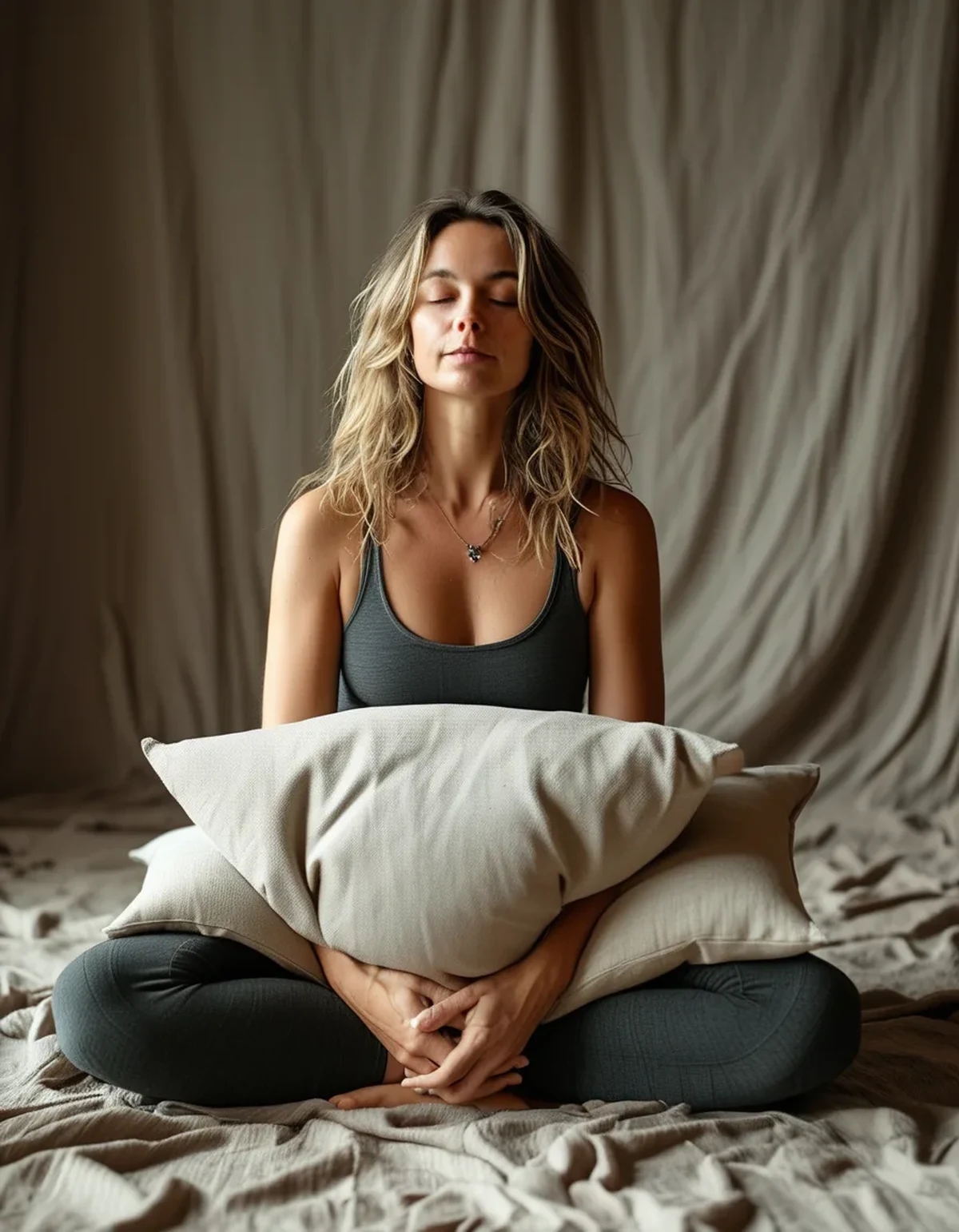
2. Support under both outer thighs. Blocks, rolled blankets, cushions — height matters more than what you use. The legs should feel held, not hanging. If there is any gap between the support and your thigh, the support is doing nothing.
3. Sit up on something. A folded blanket under the sitting bones tilts the pelvis forward and lets the hips do more of the work. If your lower back rounds hard the moment you sit on the floor, this is not optional.
Once set, test it. Hold for 60 seconds and check in. Sensation should be broad, warm, and located in the inner thigh or the front of the hip. If the knee is the loudest thing, add height under the thighs or move the feet further out — do not try to breathe through it.
What about dragon and the deeper hip poses?
Dragon is a low lunge held for a long time, and it produces knee complaints at both ends.
Front knee. Keep the shin closer to vertical, with the knee stacked over or just behind the ankle. A front knee pushed well past the toes puts sustained shear through the joint for the length of the hold. If you need more depth, walk the back knee further back rather than driving the front knee forward.
Back knee. This is a pressure problem, not a joint problem, and it is easily solved. Double-fold a blanket under the kneecap, or use the flat edge of a bolster. Practicing on a thin mat is the most common cause. If your back knee hurts, it is almost always padding, not alignment.
Front hip support. Place a block or bolster under the front hip so you are resting into support instead of holding yourself up. Yin depends on muscles releasing, and a pose you are actively holding will never let go.
For winged dragon, where the front knee rolls out to the side, go carefully. That variation adds rotation on top of flexion, and it is the version most likely to produce inner-knee sensation. Support the outer edge of the front foot with a block and reduce how far the knee rolls.
What Nobody Tells You About Yin and Knees
The sensation map matters more than the pose name. Broad, dull, warm stretch spread over a wide area is what yin is looking for. Sharp, pinpoint, electric, or anything at the joint line is not a deeper version of the same thing — it is a different signal entirely. Yin culture emphasizes staying with discomfort, and that guidance was never meant to include joint pain.
Your range changes daily, sometimes dramatically. Hydration, temperature, the previous day’s training, and where you are in your cycle all shift available hip rotation. Set up for the body you have today, which means checking prop height every practice rather than assuming last week’s setup works.
Cold rooms need more support. Tissue is stiffer below about 65°F, and yin studios are often deliberately cool and dim. If you practice in a cool room or at night, expect to need more prop height than you would mid-afternoon.
Coming out of a long hold is where injuries happen. After five minutes, tissue has crept and your position sense is dulled. Come out slowly, over 15 to 20 seconds, and give yourself a few breaths before moving into anything else.
Previous knee surgery or meniscus history changes the rules. Deep flexion combined with rotation is exactly the loading pattern those knees tolerate least. Reduce depth substantially and use more support than feels necessary, and get individual guidance rather than following a general sequence.
FAQ: Yin Yoga Knee Questions, Answered
Is knee sensation ever normal in butterfly?
A mild, broad sensation around the inner knee that spreads into the thigh is usually acceptable. Anything located precisely at the joint line, anything sharp, and anything that increases as you hold rather than easing is not. When in doubt, add support — nothing is lost by being conservative for one session.
How much prop height do I actually need?
Enough that your legs rest without any muscular effort. A useful test: relax completely and see whether your knees drop further. If they do, the props are too low.
Should I use props forever or work toward not needing them?
Props are not training wheels in yin. Many experienced practitioners use more support, not less, because the goal is releasing rather than achieving a shape. Hip anatomy varies enough that some people will never sit in an unsupported butterfly comfortably, and that is a structural fact rather than a flexibility failure.
How long should a hold be if my knees are sensitive?
Start at two to three minutes rather than five, with full support, and extend only when the shorter hold is completely comfortable. This is general information, not medical advice — persistent knee pain, locking, or swelling should be assessed by a professional.
TL;DR:
- Knee pain in hip poses means the hip is not rotating and the knee is absorbing the difference.
- In butterfly, move heels 12 to 18 inches out, support both outer thighs, and sit on a folded blanket.
- In dragon, keep the front shin vertical, pad the back knee generously, and support the front hip.
- Broad warm stretch is fine; sharp or joint-line sensation is a stop signal, not a deeper version of the same thing.
- Reset prop height every session — your available range genuinely changes day to day.
Yin rewards patience, but patience with a badly set-up pose is just five quiet minutes of loading a joint. Spend the first minute on props and the other four actually get to do what they are for.
Keep Reading
This article is for general informational purposes only and is not medical advice. Always consult a qualified health professional for guidance specific to you.