Why Yin Yoga Props Slide Around More in a Humid Room
Quick Answer: Humidity increases sweat production and reduces the natural grip between skin, mat, and props, which is a bigger problem in yin yoga than in faster-paced styles because yin’s long holds give props more time to gradually slide out of position — a grippier mat surface and slightly repositioned props help most.
You set up the perfect supported pose, settle in for a five-minute hold, and by minute three your bolster has slid an inch off-center. In a humid room, that’s not you being restless — it’s physics.
Why is yin yoga specifically more affected by humidity than other styles?
Yin yoga poses are held for three to five minutes or longer, far exceeding the brief contact time props get in most other yoga styles. Any gradual slide caused by reduced humidity-related grip has far more time to compound during a long yin hold than during the quick transitions of a flow-based practice, where a prop barely stays in one position long enough to slip meaningfully.
Humidity also increases sweat production even during yin’s low-exertion holds, since ambient moisture reduces how efficiently sweat evaporates off skin regardless of how physically demanding the pose actually is.
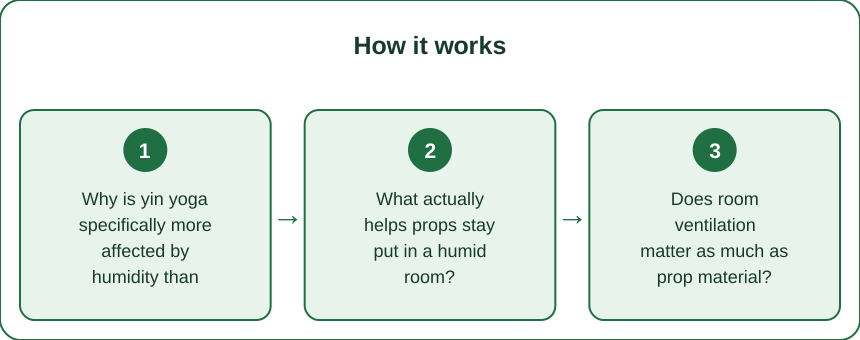
What actually helps props stay put in a humid room?
A textured or grip-enhanced yoga mat surface (rather than a smooth vinyl one) provides meaningfully more friction for props resting on top of it, even under humid, slightly sweaty conditions. Placing a small hand towel under a bolster or block’s contact point — not full coverage, just the sliding edge — can add enough friction to prevent the gradual creep that ruins a long hold’s stillness.
Does room ventilation matter as much as prop material?
It genuinely does — improving airflow with a fan (positioned to not directly blow on props, which can shift lightweight ones) or opening a window reduces ambient humidity buildup over a full practice session, which helps both comfort and the underlying grip problem. This is especially relevant in a small, enclosed practice space where a single session’s worth of sweat and breath humidity can noticeably raise the room’s moisture level by the practice’s midpoint.

What Nobody Tells You About Prop Setup in Humid Climates
Most yin yoga guides address prop placement and body alignment but rarely mention that climate and room humidity are real variables affecting how well that setup actually holds through a long practice. The same supported pose that’s rock-stable in a dry, air-conditioned studio can behave completely differently in a humid home practice space.
It’s also rarely mentioned that cork blocks tend to grip better than foam blocks in humid conditions, since cork’s natural texture doesn’t smooth out with moisture exposure the way some foam surfaces can over time — worth considering when choosing new props specifically for a humid climate.
Is this purely a comfort issue, or does prop slipping affect the practice’s benefit?
It affects both — beyond the obvious discomfort of a shifting setup, yin yoga’s benefit relies partly on sustained, passive tension on connective tissue, and a prop that gradually slides changes that tension angle without you actively choosing to adjust it. A pose that starts correctly supported and drifts out of alignment over a five-minute hold isn’t providing the same consistent stretch the whole time.
FAQ: Yin Yoga Prop Grip in Humidity Questions, Answered
Does an antiperspirant or grip powder on hands help with prop-holding poses?
For poses where hands directly hold a prop (rather than the prop just resting on the floor), a light grip powder or towel can help similarly to how it helps with mat slipping generally.
Should I avoid yin yoga in very humid conditions altogether?
Not necessary — with the right mat texture, a small towel for prop contact points, and reasonable ventilation, yin practice works fine in humid climates; it just needs slightly more setup attention than a dry-climate practice.
Does prop material (foam vs cork vs wood) matter more in humidity than at home baseline?
Yes — the grip difference between materials becomes more pronounced under humid, sweaty conditions than it would in a cool, dry room where most materials grip adequately regardless.
TL;DR:
- Humidity increases sweat and reduces grip, and yin’s long holds give slippage far more time to compound
- A textured mat surface and a small towel under prop contact points both add meaningful friction
- Better room ventilation reduces the humidity buildup that worsens grip over a full session
- Cork props tend to hold grip better than foam in humid conditions
A drifting bolster mid-hold isn’t a sign you set up wrong — it’s humidity working against grip over time, and a bit more friction at the contact points fixes it.
Keep Reading
This article is for general informational purposes only and is not medical advice. Always consult a qualified health professional for guidance specific to you.