How Long Should You Hold Yin Poses? The Case for Three Slow Minutes
Quick Answer: Yin poses are typically held two to five minutes because the target tissue — fascia, joint capsules, deep connective tissue — responds to gentle sustained load over time, unlike muscle, which responds to shorter active work. Beginners do well starting at one to two minutes per pose, building toward three as the nervous system learns to settle; three minutes is the workhorse hold, five-plus belongs to experienced practitioners in well-supported shapes. Time works only at moderate intensity — around a 4-to-6-out-of-10 sensation, never sharp, never numb — and the rebound pause between poses is part of the dose.
The first ninety seconds are negotiation. The pose starts after your body stops arguing.

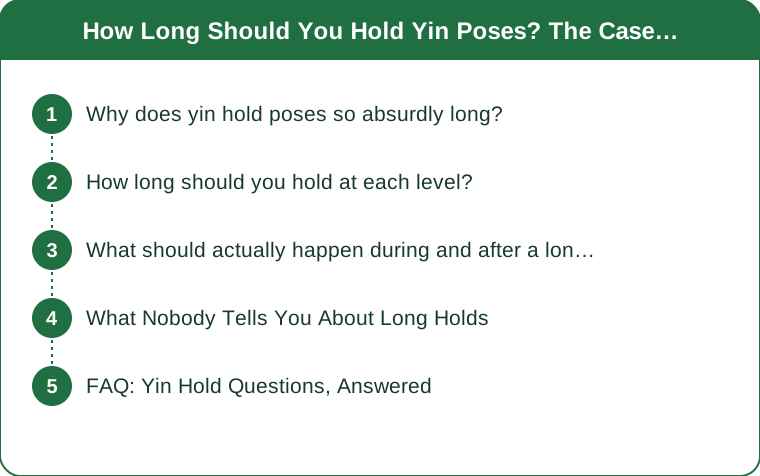
Why does yin hold poses so absurdly long?
Because the target is not muscle, and connective tissue keeps different hours.
Yin aims below the muscle layer — at fascia, joint capsules, ligaments, and the dense web of connective tissue that shapes your long-term range of motion. These tissues barely respond to the 30-second stretches of a cooldown; they are stiffer, less elastic, and slower-adapting than muscle by design, since their job is holding you together.
What they do respond to is creep — the materials-science property where sustained gentle load slowly, progressively lengthens a tissue. Creep needs two ingredients muscle stretching skips: modest intensity and lots of time. Two to five minutes is not tradition or theater; it is roughly the timescale where connective tissue begins to yield measurably.
The muscles have to clock out first. For the opening stretch of any hold, muscles guard — they contract reflexively against the new range. It takes roughly 90 seconds to two minutes of stillness for that guarding to release, which means a 60-second hold ends at approximately the moment the deep tissue was about to receive the pose. The long hold is partly just waiting for the doorman.
The nervous system runs on the same clock. The settling — slowed breath, the downshift toward rest-and-digest — that gives yin its sedative reputation does not arrive in the first minute either. Time in stillness is the active ingredient twice over.
And this is exactly why yin uses cool muscles and relaxed effort: warm, engaged muscle absorbs the load and shields the deep tissue. The passivity that makes yin look easy is what routes the gentle stress to the tissues that need it.
How long should you hold at each level?
Start at one to two minutes, live at three, earn five. The pose and the body part vote too.
Brand new to yin: one to two minutes per pose. Not because longer would injure you, but because the skill under construction is tolerating stillness — physically and mentally. Two minutes of settled beats five minutes of squirming and clock-checking in every way that matters. A phone timer with a gentle chime removes the negotiation entirely.
After a few weeks: three minutes as the standard. This is the workhorse hold — long enough for muscles to release and creep to begin, short enough to stay sustainable across a full practice of six to eight poses. If yin had a default setting, it is the three-minute hold at moderate sensation.
Experienced, well-supported: five minutes and beyond for the marquee holds — dragon, sleeping swan variations, caterpillar, a late-practice saddle for those whose knees approve. Longer holds demand more props and better judgment, not more toughness.
Adjust by region: hips, hamstrings, and glutes tolerate and reward long holds best. Spinal shapes — deep twists and strong backbends or forward folds — sit better at the shorter end of your range. Anything producing sensation near a joint line rather than in broad tissue gets shortened or re-propped immediately.
Intensity gates everything. The working zone is roughly 4 to 6 out of 10 — clearly present, entirely breathable. At 7-plus, tissue guards and time stops helping; sharp, electrical, tingling, or numb sensations mean exit now, whatever the timer says. Comfortable stretchy layers matter more here than in any other practice — buttery-soft leggings and a warm top, since cool, still bodies chill fast in long holds.
Props are what make time affordable. A bolster or cushion under the chest in folds, support under knees in swan — props do not make the pose easier; they make it sustainable at the right intensity for the full duration, which is the entire assignment.

What should actually happen during and after a long hold?
Three phases inside the pose, then the rebound — which is not optional filler.
Minute one: arrival and negotiation. Sensation is loudest here, and the mind files its objections. Find the edge — the depth where sensation reads 4-to-6 — then deliberately back off ten percent. Set your props, settle your breath low and slow, and stop adjusting. The most common beginner error is spending the whole first minute optimizing the pose instead of entering it.
Minutes two and three: the release layer. Somewhere in here the muscular guarding lets go — the pose seems to deepen on its own without you moving. This passive deepening is the hold working; resist the urge to chase it by cranking deeper. If sensation fades to nothing, sink a centimeter; if it climbs past comfortable, retreat one. Otherwise: breath, stillness, and letting the timer own the clock.
The exit: slower than dignity requires. Tissue that has been under sustained load for minutes deserves a gradual release — hands assist the leg, the spine unrolls unhurried, no springing up. Fast exits from long holds are where yin’s rare tweaks happen.
The rebound: 30 to 60 seconds of doing absolutely nothing. Lie or sit neutral between poses and just feel — the echo of sensation, warmth, the redistribution. The rebound gives tissue a moment to re-equilibrate and gives the nervous system the blank space where the settling consolidates. Skipping rebounds to fit more poses is trading the practice’s engine for its decorations.
Across a session, less is more: six to eight poses fills an hour once real holds and rebounds are counted. And across a week, two to four yin sessions is plenty — connective tissue likes its stimulus spaced.
This is general guidance, not medical advice. Hypermobile practitioners, anyone pregnant, and anyone with disc, joint, or connective-tissue conditions should get personal guidance on hold lengths and depths — long passive holds are the one yoga dial that most needs individual tuning.
What Nobody Tells You About Long Holds
The first ninety seconds are the worst, every time, forever. Even veterans feel the loud opening — the difference is they stopped interpreting it as a problem. Knowing the negotiation phase ends on schedule is half the skill of yin.
The timer is a kindness, not a crutch. An open-ended hold invites sixty small exits per minute — is it time yet? A gentle chime outsources the decision, and the mind, relieved of the clock, finally stays in the pose. Practicing without a timer is the advanced variation, not the default.
Fidgeting is usually the mind, not the tissue. The urge to adjust at minute two is overwhelmingly restlessness wearing a physical costume. The test: is the sensation actually past 6, or is it just boring? Boredom gets breath; real intensity gets a prop.
Props make holds longer, not softer. The bolster’s job is keeping you at moderate sensation for five minutes instead of forcing an exit at ninety seconds. The most propped person in the room is often getting the most yin, not the least.
Sensation the next day lands in unexpected places. Long hip holds report to the low back and inner thighs tomorrow; that broad, mild, everywhere-and-nowhere ache is normal adaptation. Sharp, localized, or joint-line pain the next day is feedback that a hold went too deep — shorten or re-prop next session.
Cold is the silent hold-shortener. A still body in a cool room tightens within minutes, and tight-from-chill tissue guards against exactly the release you are waiting for. Socks, layers, and a blanket are performance equipment in yin.
FAQ: Yin Hold Questions, Answered
Is holding a pose for five minutes better than three?
Only if you can stay at moderate sensation, supported and settled, the whole time. Three settled minutes beats five endured ones — duration multiplies quality, and it multiplies strain the same way. Build to five in the hip-focused shapes first.
Should yin poses hurt?
No. The working zone is a clear but breathable 4-to-6-out-of-10 stretch sensation in broad tissue. Sharp, electric, numb, or joint-line sensations are exit signals immediately, regardless of remaining time — and next-day sharp pain means last session overshot.
Why do I shake or feel restless during long holds?
Almost always the nervous system objecting to stillness rather than tissue in trouble — it peaks in the first two minutes and fades with practice. Slow exhales and a slightly propped-up version of the pose usually dissolve it within a few sessions.
Can I do long yin holds every day?
Most bodies do best with two to four sessions weekly, or daily practice that rotates regions — hips one day, spine and shoulders another. Connective tissue adapts to spaced stimulus; the same deep holds on the same tissue every day can leave joints feeling unstable rather than open.
TL;DR:
- Yin holds run long because connective tissue responds to sustained gentle load — and muscles need the first 90 seconds just to stop guarding.
- Start at one to two minutes, make three your standard, reserve five-plus for supported hip shapes with experience.
- Intensity gates the whole method: 4-to-6-out-of-10, never sharp, props deployed so the hold is sustainable, slow exits always.
- The 30-to-60-second rebound between poses is part of the dose, not dead time.
Tonight: three poses, three minutes each, timer chime on, blanket within reach. The first ninety seconds will argue. Outlast them once and you will understand the whole practice.
Keep Reading
This article is for general informational purposes only and is not medical advice. Always consult a qualified health professional for guidance specific to you.