What to Do When You Cannot Stay Still in a Yin Pose
Quick Answer: Restlessness in long holds usually has a physical cause - too much intensity, unsupported joints, or a position your body cannot sustain - rather than a mental one. Reduce the depth, add props, and the fidgeting typically stops on its own. Stillness is a result, not a discipline. If it is genuinely mental, that is worth working with rather than suppressing.
The fidgeting is information.
Treating it as a failure of willpower means you never read what it was telling you.
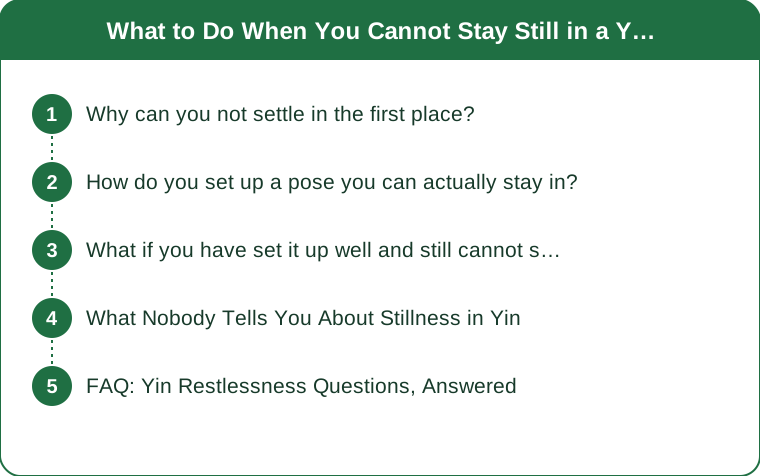
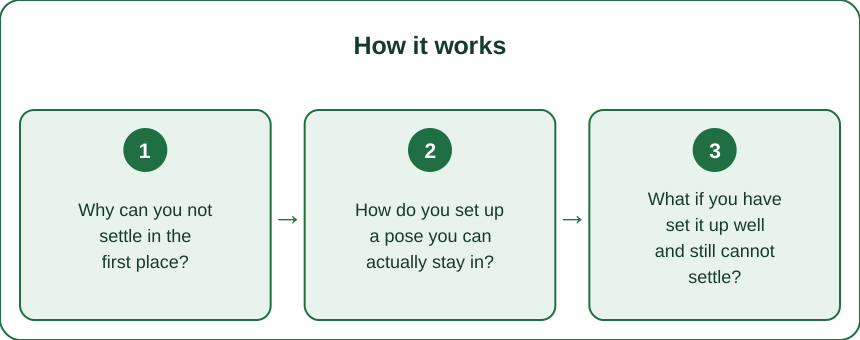
Why can you not settle in the first place?
Four causes, and three of them are physical.
The pose is too intense. Yin works at a moderate, sustainable sensation - a strong stretch you can breathe through, not the edge of your range. Too much sensation makes stillness impossible, and no amount of intention overrides it.
A joint is unsupported. A knee hanging in space, a head unsupported, or a hip that cannot reach the floor all create low-level strain that builds over minutes. The body will keep adjusting until the position is sustainable, which is exactly what it should do.
You are cold. Long stillness lowers body temperature, and a cold body fidgets, tenses, and cannot settle. This is a large factor in autumn and the easiest thing on this list to fix.
Or it is genuinely mental. A busy mind, a difficult week, or the discomfort of being alone with your thoughts can all produce physical restlessness. This is real and worth working with, and it is much less common than people assume when the physical causes are unaddressed.
Time perception makes it worse. Three minutes with nothing to do feels considerably longer than three minutes doing something, and the anticipation of remaining time drives fidgeting. Knowing the hold length helps some people and makes it worse for others.
And previous adjustments train more adjustments. Once you have moved twice, moving again becomes the default response to any sensation. The habit compounds within a single hold.
How do you set up a pose you can actually stay in?
Support first, depth second, and expect to use more props than you think.
Reduce the depth until you can breathe normally. If your breathing is tight or held, the pose is too deep - that is the clearest available signal. Normal, quiet breathing is the calibration, not a sensation rating.
Support every joint that is hanging. Blocks under knees, cushions under hips, a bolster under the chest. Anything unsupported will eventually demand attention, and it is a matter of time rather than of willpower.
Support the head in reclined and forward folds. An unsupported head means the neck muscles are working the entire hold, which is both tiring and the opposite of the intention. A folded blanket solves it entirely.
Add more props than feel necessary. The instinct is that props are for people who cannot do the pose, which is backwards - props are what let you hold it long enough to matter. More support usually means a better outcome, not an easier one.
Get warm before you start and stay warm. A layer, socks, and a blanket over you during longer holds. Cold is the most common overlooked cause of restlessness, particularly in autumn evenings and air-conditioned studios.
And settle deliberately for the first thirty seconds. Arrive, adjust once, and then commit. The permission to adjust once at the start removes the anxiety that drives adjustments later.
What if you have set it up well and still cannot settle?
Then work with it rather than against it, using five approaches.
Allow one deliberate adjustment mid-hold. A single conscious adjustment is different from continuous fidgeting, and permitting it removes the tension of resisting. Conscious movement is not failure, and treating it as such creates the struggle.
Shorten the holds. Two minutes done well is better than five minutes of squirming, and you can build up over weeks. Nothing requires long holds from the start - the duration is a target, not a rule.
Give your attention a job. Counting breaths, tracking the sensation of one specific area, or following a guided track occupies the part of you that is generating restlessness. Unoccupied attention is what fidgets, and giving it a task is more effective than telling it to stop.
Notice what the restlessness is doing. Sometimes it is boredom, sometimes anxiety, sometimes avoidance of a thought. Naming it often dissolves it, which is one of the more reliably useful things yin practice teaches.
Practise at a different time of day. Trying to be still at seven in the evening after a stimulating day is a much harder ask than first thing in the morning. Timing may be the whole problem, and it is worth testing before concluding anything about yourself.
And know the difference between discomfort and pain. Sharp, electrical, or radiating sensations, or numbness and tingling, are stop signals rather than something to breathe through. Come out of the pose - and if those sensations recur, get them assessed. This is general information, not medical advice.
What Nobody Tells You About Stillness in Yin
Almost everyone struggles with it at first. The people who look settled have usually been practising for years, and they fidgeted too. Beginner restlessness is the norm, not a personal characteristic.
Props are the mark of a good practitioner, not a struggling one. Experienced practitioners generally use more support, not less, because they know what a five-minute hold actually requires. The prop-free hero pose is a beginner’s misunderstanding.
Cold is enormously underrated. Studios cool down, evenings cool down, and a still body generates very little heat. Socks and a blanket solve more restlessness than any technique on this list.
Fidgeting often peaks around minute two. There is a common pattern where the first minute is fine, the second is difficult, and the third settles. Knowing the curve exists helps people get through the difficult part.
A full bladder or a heavy meal makes stillness nearly impossible. Both are obvious in hindsight and both catch people repeatedly. Check the boring things first.
And it improves with practice much faster than people expect. Tolerance for stillness builds over weeks, not years, provided the physical setup is right. The setup is what determines whether the practice can improve at all.
FAQ: Yin Restlessness Questions, Answered
Is it bad to adjust during a hold?
Not at all - the guidance is about avoiding constant fidgeting, not about never moving. One deliberate adjustment is normal and often what a pose needs.
How long should a beginner hold a pose?
One to two minutes is a reasonable starting point, building gradually. Long holds done badly teach nothing that shorter holds done well do not.
Why do I want to move more in some poses than others?
Usually because those poses are closer to your current limit, or because a joint is less supported in that shape. The poses you fidget in are the ones to prop more heavily.
TL;DR:
- Restlessness usually has a physical cause - too much depth, an unsupported joint, or being cold.
- Normal quiet breathing is the calibration for depth, not how strong the sensation feels.
- Use more props than feel necessary - support is what makes a long hold possible, not what makes it easier.
- Give your attention a job - counting or tracking sensation occupies what would otherwise fidget.
- Shorten the holds and allow one deliberate adjustment rather than resisting movement entirely.
Next session, put a blanket over yourself and a block under whichever joint is hanging. Most restlessness disappears before you have to work on it at all.
Keep Reading
This article is for general informational purposes only and is not medical advice. Always consult a qualified health professional for guidance specific to you.