A Yin Sequence for Feet and Ankles, the Two Joints Everyone Skips
Quick Answer: Feet and ankles carry your entire body weight all day and are almost never stretched deliberately. A yin approach suits them well, since the connective tissue on the sole of the foot and around the ankle responds better to long gentle holds than to brief stretching. A four-pose sequence — toe squat, ankle stretch, ankle circles with support, and a supported squat — takes about fifteen minutes and addresses most of it. Toe squat in particular is intense, and shorter holds are the correct starting point.
Start at 30 seconds. Nobody’s first toe squat should last three minutes.

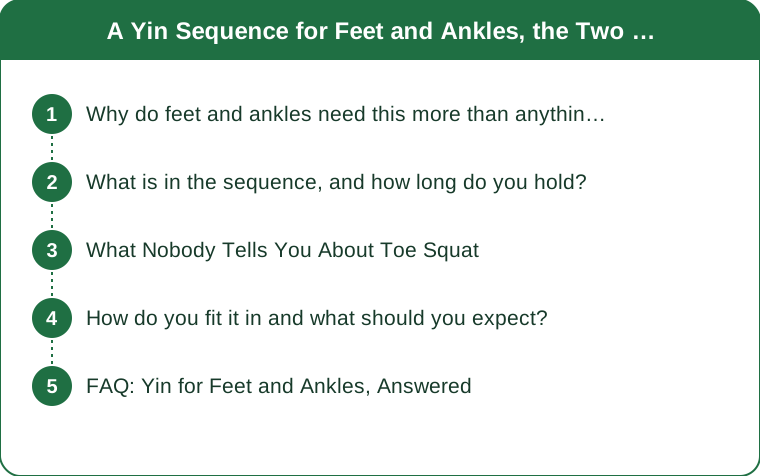
Why do feet and ankles need this more than anything else?
Because they take the most load and get the least attention.
Your feet carry your entire body weight every step. Over a day of standing and walking, they accumulate more repeated loading than any other structure, and the plantar fascia along the sole and the tissues around the ankle bear much of it.
Shoes restrict foot movement considerably. Structured, cushioned, narrow shoes with a raised heel mean the small joints of the foot move through a fraction of their available range for most of the day, and the toes in particular spend hours compressed together.
Ankle mobility limits everything above it. Restricted dorsiflexion — the ability to bring the shin forward over the foot — affects squat depth, walking mechanics, and how force travels up the leg, and it is one of the most commonly limited ranges in adults.
Yin’s long holds suit connective tissue specifically. Yin yoga targets fascia, ligaments, and joint capsules with holds of several minutes at low intensity. Dense connective tissue responds slowly, and the plantar fascia and ankle capsule are exactly that kind of tissue.
Autumn matters here. As it cools, feet spend more time in closed shoes and boots, and the barefoot summer months that gave feet natural mobility work end. This is the season where foot stiffness quietly builds.
And morning foot pain is common — stiffness and pain in the sole on the first steps out of bed is a recognisable pattern, and it responds to gentle, consistent work rather than aggressive stretching.
What is in the sequence, and how long do you hold?
Four poses, roughly fifteen minutes, with holds scaled to your starting point.
1. Toe squat — 30 seconds to 2 minutes. Kneeling with the toes tucked under, sitting back toward the heels. This is intense for almost everyone and it directly targets the plantar fascia and the underside of the toes.
Start at 30 seconds and build over weeks. Hands on the floor in front takes weight off. Sitting fully back on the heels is the full version and is not where beginners start.
2. Ankle stretch — 1 to 3 minutes. Kneeling with the tops of the feet flat on the floor, sitting back on the heels. This is the opposite of the toe squat, lengthening the front of the ankle and shin.
Put a rolled blanket under the ankles if the stretch is sharp, and a cushion between hips and heels if the knees complain.
3. Supported ankle circles and point-flex — 1 minute each side. Seated, one ankle over the opposite knee, moving the foot slowly through its full range with the hand guiding. This is more yang than yin and it belongs here because it moves the joint through ranges the static poses do not reach.
Include gentle toe separation — interlacing fingers between the toes and holding for a minute. Uncomfortable at first, and genuinely useful after weeks in shoes.
4. Supported squat — 2 to 3 minutes. Feet flat, sitting back into a deep squat with a block or cushion under the seat. The support is what makes this a yin pose rather than a strength position, and it loads the ankle into dorsiflexion passively.
Heels lifting is fine — put a rolled mat under them and work toward flat over months rather than forcing it.

What Nobody Tells You About Toe Squat
It is one of the most intense poses in yin, and its reputation is deserved. Many people cannot hold it for 30 seconds initially, which is completely normal and not a sign of anything being wrong.
The intensity is often in the toes, not the sole. The big toe joint and the smaller toe joints take a lot of the load, and people expect a plantar fascia stretch and get a toe joint sensation instead.
Weight distribution changes everything. Hands on the floor in front, hips high, takes most of the load out. Sitting back is the progression, and there is no rush.
Coming out is worse than going in. The sensation on release can be sharp for a few seconds. Come out slowly, untuck the toes gently, and give it a moment before moving.
It is not appropriate for everyone. Anyone with bunions, arthritis in the toe joints, a history of toe injury, or diabetes with reduced foot sensation should be cautious or skip it, and check with a professional first.
Sharp or nerve-like pain is a stop signal, not a challenge. Yin should feel like intense stretch or pressure, never sharp or electric.
Consistency beats duration entirely. 30 seconds daily beats three minutes once a week by a wide margin for tissue adaptation, and it is far more sustainable.
How do you fit it in and what should you expect?
Short, frequent, and at the right time of day.
Evening is the best slot. Tissue is warmer and more compliant later in the day, feet have done their work, and the sequence is calming rather than activating.
Avoid doing it cold first thing in the morning. The plantar fascia is at its stiffest on waking, and aggressive stretching then is uncomfortable and less effective. Gentle movement first, then stretch later.
Fifteen minutes, three times a week, is a realistic and effective dose. Daily is better if it is short.
Do it after a walk or a run rather than before. Long static holds before activity temporarily reduce force output, and warm tissue after activity responds better anyway.
A tennis ball or a small firm ball under the foot for a minute each side before the sequence makes everything else easier, and it is the single most popular addition.
What to expect over time: more comfortable first steps in the morning, easier deep squat position, and less end-of-day foot fatigue. Connective tissue adapts slowly — think in terms of weeks and months, not sessions.
What not to expect: immediate change, or a fix for a diagnosed condition.
When to see someone instead: heel pain that is worst on the first steps in the morning and persists for weeks, pain that is getting worse rather than better, numbness or tingling in the foot, or any foot pain in someone with diabetes. These need proper assessment, and stretching alone is rarely the whole answer.
One seasonal note: as boots and closed shoes come back, this sequence becomes more valuable, not less. The summer months of sandals and bare feet do a lot of quiet mobility work that disappears in October.
This is general information, not medical advice. Persistent foot pain should be assessed by a qualified healthcare professional.
FAQ: Yin for Feet and Ankles, Answered
Why does toe squat hurt so much?
Because the toes and the sole of the foot are rarely loaded in that position, and shoes keep the toes compressed all day. Start at 30 seconds with your hands on the floor and build over weeks.
How long should I hold each pose?
One to three minutes for most, and 30 seconds to two minutes for toe squat depending on your starting point. Consistency matters far more than length.
Can this help plantar fasciitis?
Gentle, consistent work can be part of managing foot stiffness, and persistent heel pain that is worst on the first steps in the morning needs proper assessment rather than self-treatment.
Is it better in the morning or evening?
Evening. Tissue is warmer and more compliant later in the day, and the plantar fascia is at its stiffest on waking, which makes morning stretching both less comfortable and less useful.
TL;DR:
- Feet and ankles take the most daily load and get the least deliberate attention, especially once shoes come back in autumn.
- The sequence is toe squat, ankle stretch, supported ankle circles and toe separation, and a supported squat — about fifteen minutes.
- Toe squat is genuinely intense; start at 30 seconds with hands on the floor and build over weeks.
- Evening beats morning, after activity beats before, and consistency beats long holds every time.
Set a timer for 30 seconds in toe squat tonight. That is the whole starting point.
Keep Reading
This article is for general informational purposes only and is not medical advice. Always consult a qualified health professional for guidance specific to you.