Why Yin Yoga Is Often Harder for Flexible People
Quick Answer: Yin targets connective tissue through sustained, moderate load. Flexible practitioners often sink straight to their end range, which loads the joint capsule rather than the tissue the pose intends, and removes the sensation that makes long holds tolerable. The fix is to back off to about 60 to 70 percent of your available range and use props to create resistance rather than depth.
A hypermobile person drops into pigeon, feels nothing, gets bored, and concludes yin is not for them. That is not a flexibility advantage, it is a technique problem.
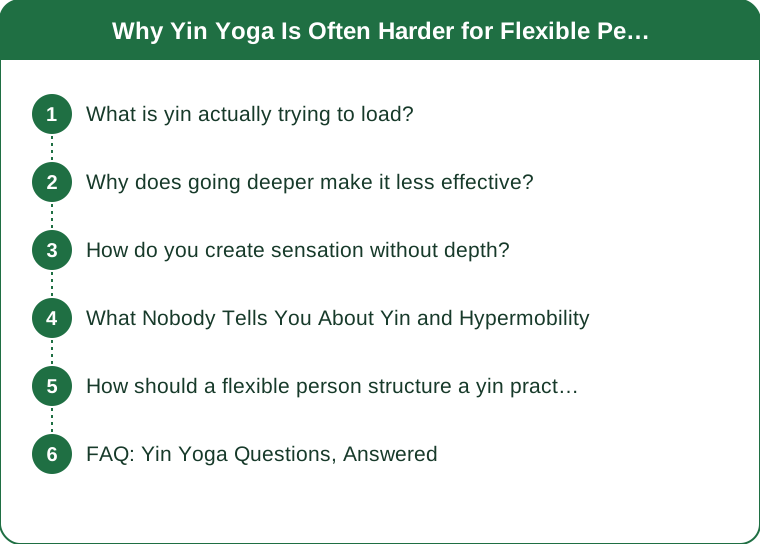
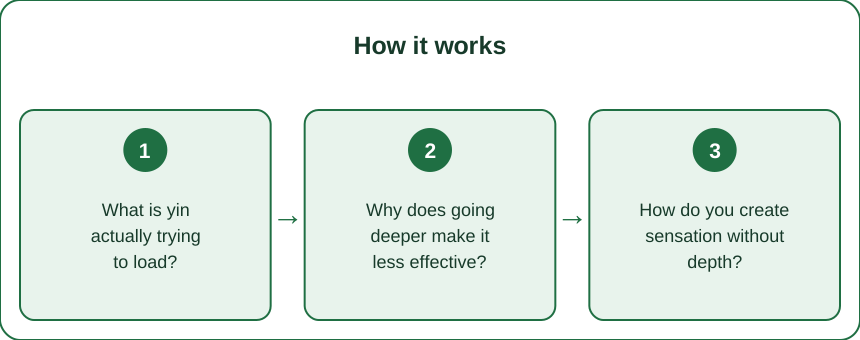
What is yin actually trying to load?
Yin targets the denser connective tissues — fascia, ligaments, and joint capsules — rather than muscle. Those tissues respond to sustained, moderate load over minutes rather than to the brief, repeated load of dynamic movement.
That is why holds run 2 to 5 minutes. Connective tissue is viscoelastic, meaning its response depends on how long the load is applied, not just how much. A 30-second hold and a 3-minute hold at the same depth are qualitatively different stimuli.
The target sensation is a diffuse, dull stretch — not sharp, not intense. Yin is not supposed to feel like a strong stretch, which is where a lot of the confusion for flexible practitioners begins.
Why does going deeper make it less effective?
Because at your end range, the tissue that stops you is different from the tissue you meant to load.
At moderate range, the load is distributed across fascia and muscle-tendon tissue. At true end range, the joint capsule and bony structures take over as the limiting factor, and sustained loading there is neither the intent of the practice nor particularly beneficial.
For hypermobile people this matters more, because end range is much further out and the joint structures reach their limit in positions that look impressive. Sustained loading at end range in a hypermobile joint is the mechanism behind a lot of yoga-related joint irritation.
The practical rule: find your maximum, then come back until you are at roughly 60 to 70 percent. If you can still feel something diffuse and steady there, you are in the right place. If you feel nothing, you need to change the shape rather than go deeper.
How do you create sensation without depth?
Change the lever, not the range. In a seated forward fold, straightening one leg and bending the other alters where the load lands entirely without adding depth.
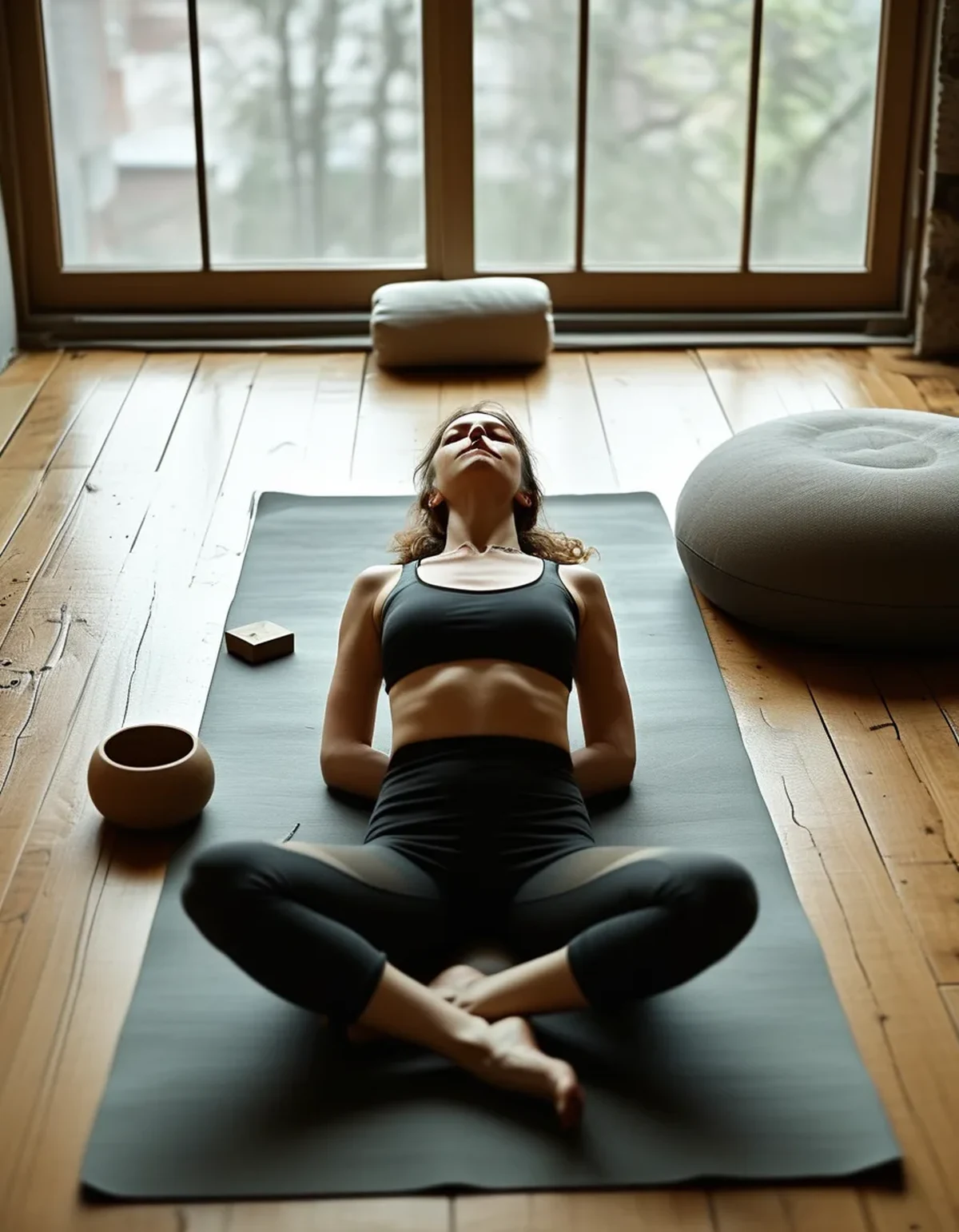
Add props for resistance rather than support. A block under your knee in a supine twist can create load rather than reduce it, depending on placement.
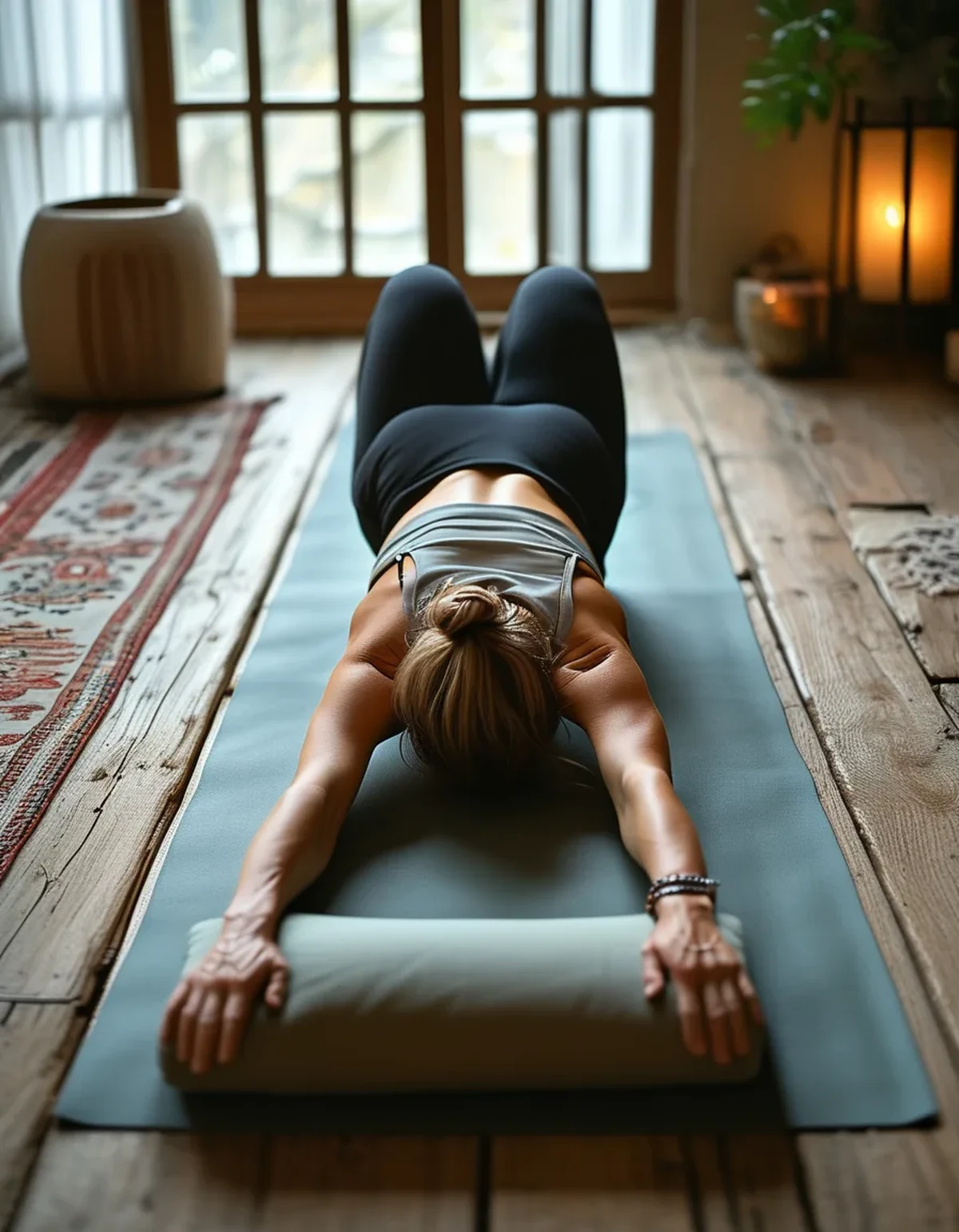
Use gravity differently. The same tissue can be loaded from a supine, prone, or side-lying orientation, and the version that gives a flexible person nothing in one orientation often gives plenty in another.
Add gentle muscular engagement. Pressing lightly into the floor in a shape, at maybe 10 percent effort, creates tension the tissue must work against and completely changes the experience for someone who normally feels nothing.
And slow the entry. Taking 60 seconds to arrive in a shape rather than 5 gives you a much better read on where your actual working range is.
What Nobody Tells You About Yin and Hypermobility
The mainstream yin instruction — go to your edge, wait, let it deepen — was written for people with average or limited range. For hypermobile practitioners it is close to advice for how to irritate your joints.
A hypermobile person does not have an edge in the same way. They have a point where tissue tension appears and a point where the joint runs out of structure, and those two points are far apart with very little sensation in between. Waiting for a strong signal means waiting until you have arrived somewhere you should not be.
The second thing nobody says: passive stretching may be actively counterproductive for hypermobile people. What generally serves better is strength through range — building control at the outer portions of your available motion so your joints have active support where passive support is lacking.
That does not mean yin is off limits. It means yin done at moderate range, with prop-supported positions and some light engagement, is a reasonable practice, and yin done as deep passive holds probably is not.
A practical marker: if you feel notably loose, unstable, or achy the day after a yin practice, the practice was too deep. Sore is normal-ish; unstable is a signal.
And the thing that surprises most flexible people — a yin practice done correctly at 60 percent depth is often the first time they have felt anything in a yoga class in years. The sensation was never absent. They were just moving past it too quickly to notice.
How should a flexible person structure a yin practice?
Fewer shapes, longer holds, more props. Four or five poses at 4 to 5 minutes each is a better session than ten shapes at 2 minutes.
Spend the first minute of every hold finding the right depth rather than settling into your maximum. This is the habit change that matters most, and it takes several sessions to feel normal.
Pair it with strength work in the same week. For hypermobile people, yin without any strength training is the combination most likely to cause problems, and yin alongside two strength sessions is a genuinely good pairing.
And pay attention to the day after. The useful feedback from yin arrives at 24 hours, not during the session, which is the opposite of most training and the reason people get the depth wrong for years without noticing.
FAQ: Yin Yoga Questions, Answered
How long should a yin hold really be?
Two to five minutes is standard. Under two minutes and you are not reaching the viscoelastic response yin is built around; beyond five, returns diminish and discomfort tends to dominate.
Is yin safe for hypermobile joints?
At moderate depth with props, generally yes and often beneficial. At deep passive end range, it is a reasonable concern. Anyone with a diagnosed hypermobility condition should get individual guidance — this is general information, not medical advice.
Can yin replace a mobility routine?
They serve different purposes. Yin loads connective tissue passively; mobility work builds active control through range. Most people benefit from both, and hypermobile people benefit disproportionately from the second.
TL;DR:
- Yin targets connective tissue with sustained moderate load, not muscle with intense stretch.
- Flexible practitioners often sink past the target tissue straight to the joint capsule.
- Work at 60 to 70 percent of your range, change levers rather than depth, add light engagement.
- Judge the practice by how you feel the next day, not during the hold.
Being flexible does not make yin easy — it makes it easy to do wrong. Back off two inches from where you would normally go and the practice you thought was pointless usually turns out to be the one you needed.
Keep Reading
This article is for general informational purposes only and is not medical advice. Always consult a qualified health professional for guidance specific to you.