Why Yin Yoga's Benefit Depends on Hold Time Far More Than Pose Difficulty
Quick Answer: In yin yoga, duration does the work — not depth. Connective tissue like fascia and ligaments reshapes gradually under mild sustained load over minutes, while muscle responds to intensity in seconds. That’s why the target is 3–5 minutes per pose at mild-to-moderate intensity. A deep, impressive pose you can only hold for 45 seconds produces less of the intended effect than an easy one you can sit in for four minutes. Pick poses you can sustain, and use props to make that possible.
Two people in a yin class. One is folded almost in half, breathing hard, out of the pose at ninety seconds.
The other is propped up on two bolsters looking like they’re about to fall asleep, still there at minute four.
The second one is doing yin. The first one is doing a stretch.
Why Does Time Matter More Than Depth?
Because yin targets a different tissue than most stretching does, and that tissue keeps different time.
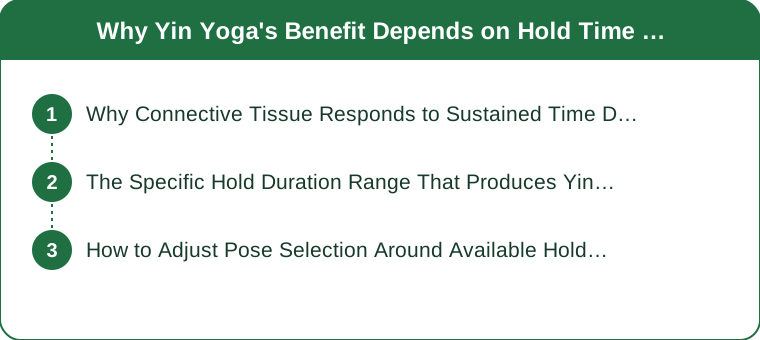
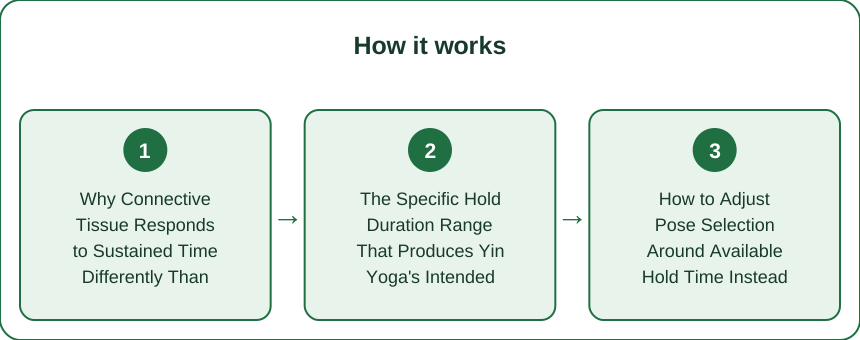
Connective tissue changes over minutes, not seconds. Fascia and ligaments respond to sustained mild stress by gradually reorganizing — a genuinely slow process operating on a minutes-long timescale. Muscle, by contrast, responds to a stretch or contraction within seconds. Same body, two completely different response curves.
So intensity and duration trade off, and duration wins here. A deep, intense pose held briefly produces far less of that slow adaptive response than a milder pose held much longer. This is the exact opposite of how most strength and flexibility work operates, which is precisely why yin confuses people coming from other training.
Muscle stretching and connective tissue work aren’t the same practice. Dynamic stretching, active flexibility work, and a typical vinyasa forward fold are all aimed primarily at muscle. Yin is aimed past it. Applying muscle-stretching instincts — go deeper, feel more, push the edge — actively works against what yin is trying to do.
How Long Should Yin Poses Actually Be Held?
Three to five minutes is the working range. That duration is calibrated to the tissue response above, not chosen arbitrarily. Most yin sequences build around it.
Under about two minutes, you’re mostly still working muscle. Short holds don’t give connective tissue enough time to begin responding. A 60-second hold isn’t a shortened yin pose — it’s a different exercise that happens to look similar.
Intensity stays mild to moderate because the hold is long. This is the piece people fight hardest. On a scale of 1–10, you want a 3 or 4, not a 7. You should be able to breathe normally and hold a conversation. If a pose demands 5 minutes at a 7, you’ll bail at 90 seconds and get neither the duration nor the depth. Reduce the intensity until the duration becomes possible — that’s the whole trade.
Beginners can start at 2 minutes and build up over a few weeks. There’s no benefit in white-knuckling a 5-minute hold you hate.
Myth vs Fact
Myth: A more advanced-looking pose is a more effective pose. Fact: Effectiveness in yin is measured in minutes sustained, not in how the shape photographs. A supported butterfly held for 5 minutes does more than an unsupported one abandoned at 90 seconds.
Myth: Props are for beginners. Fact: Props are duration tools. A block under the hip or a bolster under the chest lowers the intensity to a level you can actually sustain for the full hold — which is the entire mechanism. Experienced yin practitioners often use more props, not fewer, because they understand what they’re buying.
Myth: You should feel a strong stretch or it isn’t working. Fact: Strong sensation is a muscle-stretching cue that doesn’t transfer here. In yin, a mild steady sensation that stays tolerable for four minutes is the target. If the sensation is intense enough to be interesting, it’s probably too much.
Myth: More poses means a better session. Fact: A 30-minute session is six poses, not fifteen. Do the division.
How Do I Build a Session Around This?
Pick poses you can sustain, not poses you can reach. The selection criterion is: can I stay here at a 3 or 4 out of 10 for the full 3–5 minutes? If no, pick an easier variation. You’re not settling — you’re choosing the version that works.
Use props specifically to enable duration. Blocks under the knees in butterfly, a bolster under the torso in a supported fold, a rolled blanket under the hips. The question to ask isn’t “does this make it easier” but “does this let me stay here for four minutes.” Those are different questions with different answers.
Plan by time budget, not pose count. Divide your available time by your hold target. Thirty minutes at 4-minute holds is 7 poses, allowing for transitions. Forty-five minutes is 10. Building a list of poses first and then discovering you only have 90 seconds each is the most common way people accidentally stop doing yin without noticing.
Mini FAQ
What should I do with my mind for four minutes?
Most yin instruction encourages simply staying with the breath and the sensation. Long holds are genuinely uncomfortable mentally for a lot of people at first — that’s normal, and it settles with practice. A guided recording helps early on.
Can I do yin every day?
Most practitioners do 2–4 sessions a week. Daily is possible with mild intensity, but connective tissue adapts slowly and there’s no benefit to rushing it.
When should I be careful or check with a professional?
Come out of any pose that produces sharp, shooting, or nerve-type sensation rather than a mild stretch — that’s not the tissue you’re aiming for. Anyone with hypermobility, a recent joint injury, osteoporosis, or who is pregnant should talk to a physical therapist or an experienced instructor before doing long passive holds, since sustained end-range loading isn’t appropriate for every body.
TL;DR:
- Connective tissue reshapes over minutes; muscle responds in seconds. Yin targets the slow one.
- Target hold: 3–5 minutes per pose. Under 2 minutes mostly works muscle instead.
- Keep intensity at 3–4 out of 10 — mild, because duration is doing the work.
- Props exist to make the long hold possible, not to make you a beginner.
- Plan sessions by time divided by hold length, not by number of poses.
Keep Reading
This article is for general informational purposes only and is not medical advice. Always consult a qualified health professional for guidance specific to you.